My son melted down in a grocery store last Tuesday. I’d read every parenting book — yet there I was, bribing a four-year-old with a snack just to leave.
That same week, I found footage of a 6-year-old Japanese child navigating Tokyo’s subway system. Alone. Calm. Purposeful.
These children spend their first three years in near-constant physical contact with their mothers — then top the world in self-regulation research (Keller et al., 2004) and PISA rankings (OECD, 2022). Not despite their parenting philosophy. Because of it.
Every article on the Japanese parenting style describes what Japanese parents do. None explain the mechanism. Child development research — from Baumrind’s 1966 framework to Heidi Keller’s cross-cultural studies — reveals something uncomfortable. Japanese parenting styles contradict the independence-first model. Western culture tells parents to follow it without question.
If you have ever second-guessed yourself for staying close, you need words of encouragement for mothers more than any other parenting rule. The explanation begins with a concept that changes everything.
THE PSYCHOLOGICAL FOUNDATION OF WESTERN ARTICLES
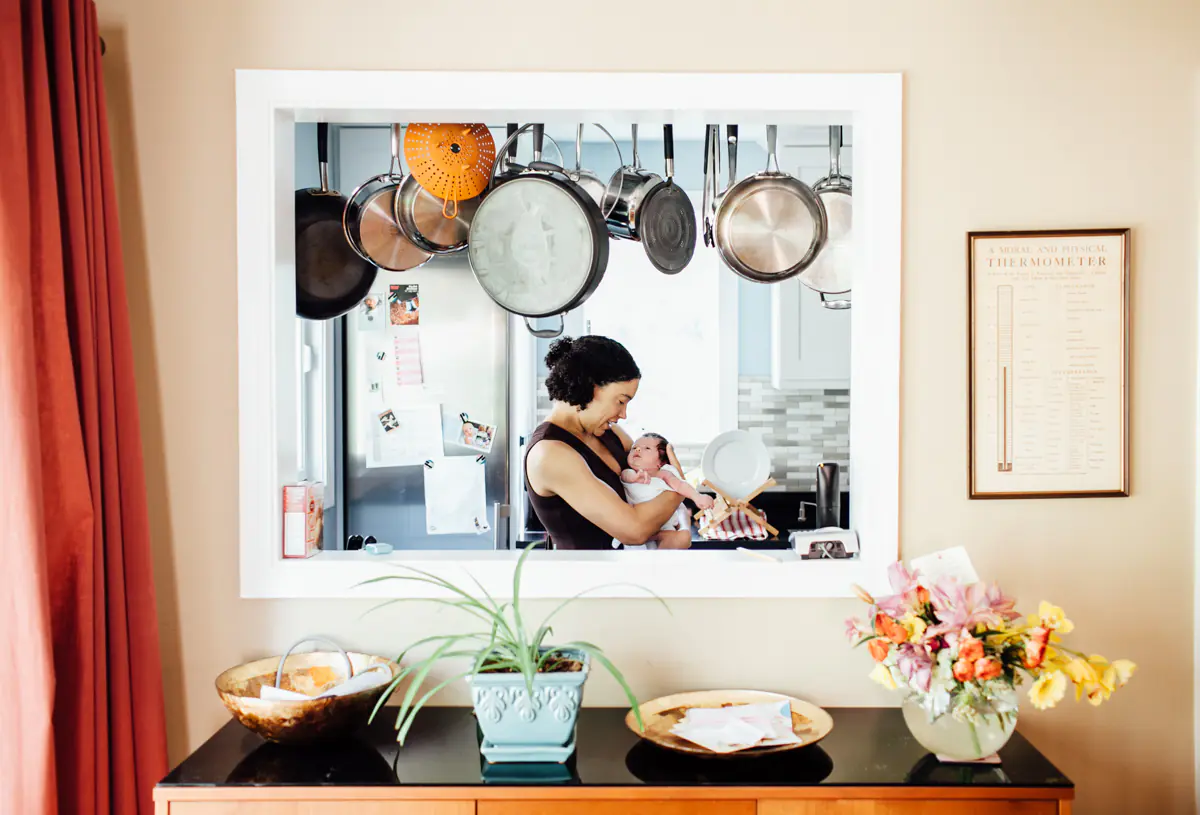
Amae (甘え) is the psychological foundation of the Japanese parenting style. Psychiatrist Takeo Doi coined the term for sanctioned emotional dependence. A child’s certainty that their caregiver will always respond forms the secure base from which genuine independence grows.
When my daughter was eight months old, my mother-in-law told me I was making a rod for my own back by responding to every cry. Japanese mothers respond to every cry, too — and raise children who walk to school alone at six.
What Amae Actually Means
Turns out there is a name for what Japanese mothers are doing — and it explains everything. The concept is simpler than it sounds: not permissiveness, more like I will always come, and you will always know it. Rothbaum et al. (2000) found Japanese infants classified as ‘overly dependent’ by Western scales were, by Japanese standards, securely thriving.
Amae is not uniquely Japanese. The elephant parenting style shares the same foundation as fierce early closeness that builds the security children need before independence is possible.
Why Amae Rewires the Independence Model
Japanese mothers practice amae through anticipating needs — responding before distress appears, building emotional attunement (Siegel, 2012). They spend just 2 hours weekly away from infants versus 24 hours for American mothers (Keller, 2003). That near-constant presence is exactly what the warm demandingness of amae requires.
Every early childhood development researcher I read told me to pull back. Sroufe et al.’s (2005) 30-year study says the opposite: closeness is not the obstacle to independence. It is how independence actually gets built.
THE SCIENCE BEHIND SKINSHIP
I carried my son everywhere until he was two. My pediatrician called it unhealthy. Thirty peer-reviewed studies call it essential. Skinship — physical closeness as emotional language — is neuroscience, not sentiment.
What Skinship Does to the Developing Brain
Consistent skin-to-skin contact measurably reduces infant cortisol stress responses by 12 months (Feldman, 2017). Lower cortisol means a calmer baseline nervous system — the biological foundation of child self-regulation. This is proximal parenting — Heidi Keller’s term for body-first caregiving, defining the Japanese approach. Keller found that proximal parenting predicts emotional regulation in children 3–6 months earlier than Western alternatives.
Approximately 70% of Japanese families co-sleep versus 20% in the US (Mindell et al., 2010) — yet Japan records infant mortality of 1.7 versus 5.4 per 1,000 in the US (WHO, 2022). The country most associated with co-sleeping is least associated with infant death. Simple safety narratives don’t survive that data.
Here is what nobody told me: before children can calm themselves, they need to borrow calm from you. Porges’ Polyvagal Theory (2011) explains how. The infant’s nervous system borrows calming capacity from the caregiver’s. Every time you stayed calm when your baby screamed, the evidence suggests you were wiring their brain. Bowlby called this the secure base. Neuroscience finally caught up.
The Paradox: How Attachment Parenting Builds Independent Children
The children of Hajimete no Otsukai — Japan’s TV show following toddlers on solo errands since 1991 — were among the most physically held children in the world. Three years later they navigated Tokyo’s streets alone. Not a contradiction. A sequence.
Think about the toddler who keeps running back to check you’re there. That is not clinginess — that is the secure base in action. Ainsworth et al. (1978) showed securely attached infants explored more freely because they knew someone was there if things went wrong. Bernier et al. (2010) found securely attached children scored 35% higher on executive function measures by age 5.
The Western instinct to push independence early may actually delay it. Children pushed toward autonomy too soon spend their energy managing anxiety. They have none left for exploring.
Independence is not taught. It is grown in the arms of a present parent.

HOW JAPANESE CHILDREN LEARN WITHOUT BEING TAUGHT
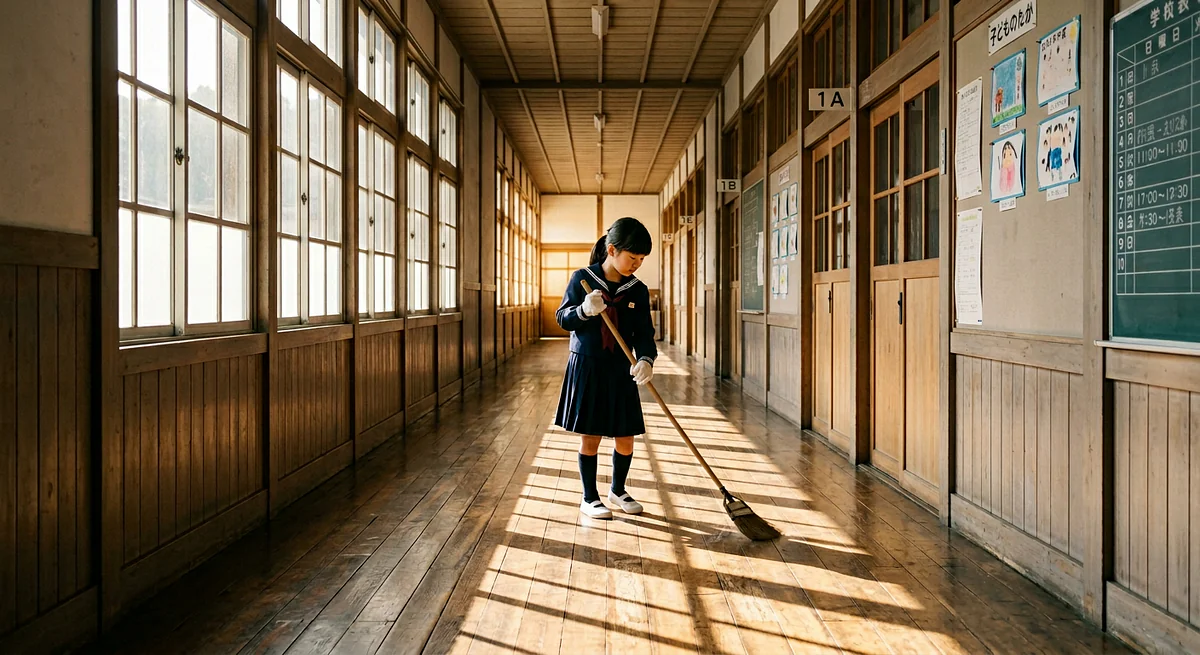
I asked my 7-year-old to clean his room last week. Twenty minutes of negotiation. Nobody tells Japanese children to respect their school. They clean it instead — floors, toilets, windows. Daily. Without being asked.
Shitsuke — Discipline as Embodied Practice
Shitsuke (躾) combines ‘body’ and ‘beautiful’: behavior embodied until instinct — owned, not enforced. It is the daily practice of wa (和) — harmony — absorbed before a child can name it.
Japanese parents rarely say ‘stop that.’ They say: ‘How do you think that made your friend feel?’ I rolled my eyes at this, too — then I tried it for a week. Gottman (1997) calls it emotional coaching — the single parenting behavior most predictive of resilience.
Lewis (1995) documented something remarkable. Japanese preschool teachers use the same language. The emotional coaching that starts at home extends into every classroom hour.
What Japanese Schools Do That Parents Don’t Have To
Every Japanese elementary school practices osoji — whole-school cleaning by students. No janitors. No exceptions. Tobin et al. (2009) found 87% of Japanese preschool teachers stepped back from peer conflict versus 31% of American teachers. Children build collectivism by resolving tension themselves.
Discipline without punishment is not a technique. It is a cultural infrastructure spanning home, school, and community.
The most transferable element: not osoji, not solo commuting — but the daily language of consequences.
But before you borrow any of it — you need to see the full picture.
WHAT RESEARCH SAYS ABOUT THE JAPANESE PARENTING STYLE
I used to share Japanese parenting content online with the caption “Why can’t we do this?” Then I found the numbers nobody shares.
The Child Development Research That Surprised Me Most
Japanese parenting produces outcomes that researchers rank among the strongest globally — top 5 in PISA (OECD, 2022), stronger executive function, and higher prosocial behavior (Zahn-Waxler et al., 1996). Though it is worth noting: PISA scores may reflect Japan’s juku exam culture as much as its parenting philosophy.
Here is the one that stopped me. Heckman (2006), a Nobel laureate, found that early self-regulation predicts lifetime earnings and health better than IQ. Not test scores. Not early reading. Self-regulation. Heckman found the return exceeds 13% per year — higher than any financial market. Self-regulated children cost society less across their lives.
The Numbers That Complicate the Story
No admiring article mentions these costs:
- 1.46 million hikikomori — severe social withdrawal (Cabinet Office, 2023)
- Child suicide leads causes of death for Japanese ages 10–14 (Ministry of Health, 2023)
- 70% of elementary students attend juku cram schools by age 10 (MEXT, 2021)
- Despite the ikumen campaign since 2010, paternal childcare increased just 20 minutes per day over a decade (Tsutsui, 2022)
Within Japan’s collectivist framework — what psychologists call interdependent self-construal — emotional regulation strengths and shame-response risks share the same root (Kitayama et al., 2010). The culture that builds the world’s most self-regulated children also leads the G7 in child suicide.
That is not a contradiction. It is a warning.
Japanese Parenting Style vs Western Parenting: Key Differences
| Dimension | Japanese Approach | Western Approach |
| Early years | Maximum closeness — amae | Early independence training |
| Discipline | Shitsuke — embodied values | Rule-based compliance |
| School | Osoji — collective duty | Individual achievement |
| Outcomes | High self-regulation, PISA | Earlier self-expression |
| Risks | Hikikomori vulnerability | Anxiety, compliance issues |
WHAT MOST ARTICLES NEVER TELL YOU ABOUT JAPANESE PARENTING
I almost didn’t include this section. Every article on the Japanese parenting style stopped before the hard part. I’m not going to.
The Shadow Side of Harmony
Japan’s collectivist parenting produces remarkable self-regulation — and one specific vulnerability. A child who only learns to belong never learns to recover from rejection.
Researcher Saito Tamaki (2013) reframes hikikomori: not laziness, not weakness — shame regulation collapse. When the group rejects a child shaped for belonging, they have no tools for recovery. Withdrawal is the only protection a nervous system without emotional vocabulary knows.
Schore (2003) found that unregulated shame physically alters prefrontal cortex development. That is the same brain region on which self-regulation depends. The greatest strength and the deepest vulnerability share the same address.
The Fix That Protects Emotional Resilience
Amae without emotional vocabulary produces connection-dependent children, not resilient ones (Gottman, 1997). The fix: pair closeness with words. Teach children to name feelings before the group requires silence — Gottman & DeClaire (1997) found this reduces behavioral problems by 35%.
A child who can say “I feel left out” can recover. A child taught only silence cannot.
WHAT WESTERN PARENTS CAN ACTUALLY BORROW
I spent three weeks trying to get my daughter to walk to the corner store alone. Wrong starting point. The most transferable part of Japanese parenting is not a practice. It is a posture.
Three Things Western Parents Can Borrow From Japanese Parenting Today
Kochanska (1994) found warmth-raised children internalize values willingly, complying at twice the rate of insecurely attached peers. Hart & Risley (1995) found that daily conversational quality predicts social competence more than income or education.
Three things any parent can start today:
- Narrate impact, not rules. Instead of ‘stop grabbing,’ say ‘when you grab, your friend feels hurt.’ Empathy builds faster than fear.
- Assign real responsibility from age 3. Genuine tasks — not toy chores — build intrinsic motivation (Deci & Ryan, 2000).
- Model kodawari — devotion to craft. You don’t need a bento box. The child watching you redo something until it’s right is absorbing a standard. Bandura (1977) called it observational learning. Japanese parents call it Tuesday.
The three practices above — narrating impact, assigning real responsibility, and modeling craft — will feel familiar if you have explored the Montessori parenting style. Both approaches build intrinsic motivation the same way: through genuine contribution, not reward or punishment.
Here is what this looks like in practice: a child who cleans because they genuinely care about shared space behaves differently from a child who cleans to avoid punishment. Japanese parenting builds the first child. Most Western discipline systems build the second.
What Requires the Cultural Infrastructure
Solo commuting requires Japan’s safety infrastructure — 0.2 versus 6.3 homicides per 100,000 (UNODC, 2022). Osoji requires whole-school adoption. Neither travels.
The language does. Modeling behavior is free. It works faster than anything else you will try.
FREQUENTLY ASKED QUESTIONS
What is the Japanese parenting style called?
The Japanese parenting style is built on amae — Takeo Doi’s (1971) term for sanctioned emotional dependence that grows into genuine independence. I spent months thinking it was spoiling. It was foundation-building.
Why are Japanese children so independent?
Japanese children develop independence through sequence, not separation. Sroufe et al. (2005) found securely attached children became the most autonomous adults in a 30-year cohort. Skinship builds the nervous system that makes independence feel safe.
How do Japanese parents discipline without shouting?
Japanese parents discipline through shitsuke — behavior embodied until instinct. They narrate consequences rather than issue commands: ‘How does that make your friend feel?’ Gottman (1997) found that this emotional coaching reduces behavioral problems by 35%. I tried it for two weeks. The difference was uncomfortable to admit.
Is Japanese parenting better than Western parenting?
Neither is superior. Japanese parenting produces exceptional self-regulation and PISA scores — and 1.46 million hikikomori (Cabinet Office, 2023). Kagitcibasi (2005) identified a better goal than either: the autonomous-relational child — securely connected and independently capable.
What can Western parents borrow today?
Western parents can start with three practices: narrate impact over rules, assign real responsibility from age 3, and model kodawari daily. Hart & Risley (1995) found that daily conversational quality predicts social competence more than any other parenting variable. Harder than expected. More effective than anything else I tried.
THE LESSON JAPANESE PARENTING ACTUALLY TEACHES
I still bribe my kids. Last Tuesday — screen time. But I know the sequence now. Presence first. Independence second. Amae before autonomy.
You cannot transplant Tokyo into your living room. But Van IJzendoorn & Sagi (1999) reviewed 32 cultures and found the same result in every one: secure attachment predicts healthy independence. This was never about Japan. It was always about children.
The bento box, the subway commute, the spotless school — these are what security looks like once it has been built. They are the evidence, not the method.
The most important thing the Japanese parenting style teaches is not a technique. It is a direction: toward the child first. Build it first. Everything else follows.