Kashmala Tariq is a dedicated parenting writer and mother of three with over 10 years of experience in raising children. Based in Australia, she shares insights on parenting styles, technology, children’s dressing, and common parenting challenges. Her goal is to support and inspire parents with helpful, easy-to-follow guidance for raising happy and healthy kids.
Sixty years of research have produced one finding parents rarely hear: the gentle vs traditional parenting debate is the wrong question.
You held firm on bedtime and spent an hour wondering if you’d caused lasting damage. You validated the meltdown and worried you’d raised a child who never hears no. Both approaches. Same guilt. The guilt is the problem — not you.
What attachment theory confirms about gentle parenting vs traditional parenting: the answer was never gentle or traditional. It was always warm but firm. Pew Research (2023) shows 57% of parents already practice this without knowing it — and Rohner’s 54-country study found the one variable that predicted whether children thrived.
Your child’s temperament, your nervous system, and what happens after you get it wrong — three things no competitor article addresses — are where this debate is won.
What Gentle and Traditional Parenting Really Means
Most parents are already somewhere in the middle. Here is what each approach means — and where both go wrong.
What Gentle Parenting Actually Means
Gentle parenting is harder than it looks on Instagram. It is not soft voices and hour-long emotion processing sessions. It is attachment theory in practice — consistent limits, delivered without shame, while managing your own emotional state simultaneously.
When the tantrum hits, most parents either match the energy or shut it down. Neither works. Siegel’s window of tolerance research (2011) shows children cannot process correction when flooded — they are neurologically unavailable.
Try: “You’re really upset. I hear you.” Then redirect. Four seconds to say. Years of practice mean it. Parents who practice this consistently often find it aligns closely with the democratic parenting style — where the child’s voice is heard without removing the parent’s authority.
What Traditional Parenting Actually Means
Traditional parenting has a reputation problem. It gets blamed for everything harsh and punitive — which is authoritarian parenting, not traditional.
Traditional parenting at its best is Baumrind’s authoritative style: warm, structured, consistent. It means being the parent who actually leaves the park. Every time. No second chances. Hoffman (2000) found that children internalize values more deeply when consequences are logical. The child who learns “this parent means what they say” stops testing limits — because they already know the answer.
The Real Spectrum — From Permissive to Authoritarian
Permissive parenting produces children who struggle with frustration tolerance. The authoritarian extreme produces obedience — but not values. Deci and Ryan (2000) confirm that fear-based compliance never becomes self-directed behavior.
Both approaches, practiced well, land in the same place. Steinberg (2014): “Warmth without firmness is indulgence. Firmness without warmth is harsh.” You felt it the last time you held firm without losing your temper. That balance — sometimes called assertive parenting — is the natural destination of both approaches when practiced with intention.
What Gentle and Traditional Parenting Really Means
What 60 Years of Research Confirms About Gentle Parenting vs Traditional Parenting
Sixty years of research into gentle parenting vs traditional parenting. One answer. Nothing to do with which approach you choose.
The Warmth-Plus-Structure Finding
Diana Baumrind (UC Berkeley) and John Gottman (University of Washington) agree: child outcomes are most strongly predicted by warmth and structure together — never separately.
Children raised warm but firm showed measurably better emotional regulation, secure attachment, and academic performance (Gottman et al., 1996). Rohner studied parents across 54 countries (2004) and found one thing mattered more than any technique: whether the child felt loved. Not the rules. Not the consistency. Whether they felt loved.
Gottman (1997): “The goal is not to prevent the child from feeling things but to help them navigate feelings.” What most parents miss: “I can see you’re frustrated“ takes four seconds — and it is what makes everything that follows land.
Why Your Child’s Temperament Changes Everything
Two siblings. Same parents. Same house. Completely different responses to identical discipline.
Belsky’s differential susceptibility research (1997) explains why some children are more sensitive to parenting style than others. Thomas and Chess (1956–1988) found parenting works best when it fits your child’s temperament — goodness of fit.
The parent who stopped feeling like a failure when they realized their sensitive daughter needed empathy-first, while their strong-willed son needed firm limits, wasn’t wrong. The child was different. The same values look completely different with different children.
That’s not inconsistency. That’s the job — and it looks different depending on your cultural context.For highly sensitive children in particular, parents instinctively drawn to the elephant parenting style — protecting fiercely while nurturing emotional safety above all — often find goodness of fit comes naturally.
The Most Surprising Finding — Alignment Beats Approach
Dad held firm consequences. Mum processed feelings first. Their son learned one thing — ask Mum. The problem was neither parent’s approach. It was the absence of parenting alignment.
Feinberg (2003) confirms it: aligned caregiving predicts outcomes more strongly than which approach either parent uses.
Before the next meltdown — not during it. Decide together. Hold it.
YOUR CONSISTENCY MATTERS MORE THAN YOUR METHOD
Two parents. Same home. Different rules. Feinberg (2003): alignment predicts outcomes more strongly than method. Alignment beats approach — every time.
Today: agree on two non-negotiable limits with your co-parent.
What 60 Years of Research Confirms About Gentle Parenting vs Traditional Parenting
The Practical Framework That Works at Every Age
Every parent knows the right answer at 9 am. Almost nobody executes it at 7 pm. Here is why.
Start With Your Own Nervous System — The Co-Regulation Foundation
Before any strategy, your calm is the intervention.
Your nervous system talks to your child’s before you open your mouth. Feldman (2007) found this synchrony measurable within seconds. Porges’ Polyvagal Theory (2011): a calm parent physically moves a child from fight-or-flight back into learning. You are not managing behavior. You are regulating biology.
The nights you breathe instead of snap — everything works, including time-outs. The nights you’re flooded — nothing does.
The Age-Calibrated Approach
Positive parenting shifts at every stage — here is what that looks like.
Age Stage
Primary Need
Discipline Strategy
Toddler 2–5
Calm presence
Name emotions, redirect, stay calm
School-age 6–12
Logical thinking
Natural consequences, problem-solving
Teen 13+
Autonomy
Collaborative rules, negotiated limits
For children with ADHD or sensory differences, natural consequences work best when linked immediately to behavior. The parent who hit a wall at thirteen isn’t failing — they’re still using a five-year-old’s playbook. The brain changed. The expectations didn’t.
Prefrontal cortex development continues until age 25 (Casey et al., 2000) — structure gradually gives way to autonomy. Parents who find the toddler row most natural often discover they are already applying principles of the Montessori parenting style — following the child’s lead while holding the environment firmly in place.
Steinberg (2001) found that top-down enforcement loses effectiveness after twelve. Siegel’s name-it-to-tame-it research (2011) explains why the toddler row works. Labeling emotions reduces amygdala activation — children calm faster when you name what they feel. Ross Greene: “When we approach behavior as a problem to solve together, we get far better outcomes with far less conflict.”
When You Get It Wrong — The Repair Conversation
Last Tuesday, you yelled. It happens.
Tronick (Harvard, 1989) found that repair after conflict strengthens the parent-child relationship more than uninterrupted harmony. Use this script: “I lost my temper — that wasn’t okay. Let’s talk about what happened.”
That five-minute conversation builds self-regulation, accountability, and trust — raising emotionally intelligent children through imperfect moments. The repair is not the failure. It is the lesson.
REPAIR TEACHES MORE THAN PREVENTION
Tronick (Harvard, 1989): repair builds stronger attachment than uninterrupted harmony. Your child doesn’t need a perfect parent. They need one who comes back.
Today: return calmly after your next difficult moment.
The Practical Framework That Works at Every Age
Gentle Parenting vs Traditional Parenting — FAQ
Does gentle parenting spoil children?
Only if you confuse it with permissive parenting. Spoiling comes from no limits and no follow-through — not from empathy.
Is traditional discipline harmful?
Only the authoritarian extreme. Lamborn et al. (1991) followed 10,000 adolescents. Warm, structured parenting built resilience. Harsh enforcement produced anxiety. The method isn’t the problem. The absence of warmth is.
Can you combine gentle parenting vs traditional parenting?
You already are combining gentle parenting vs traditional parenting. Most parents validate feelings on Monday, hold the line on Tuesday, and repair after losing it on Wednesday. That is authoritative parenting — what Baumrind’s research shows outperforms either approach used rigidly alone.
What if my child ignores every boundary I set?
A child who pushes every limit often isn’t defiant — they’re confused. Feinberg (2003): When co-parents apply different rules, children follow neither. Consistent limits between caregivers matter more than which limits you choose.
Does repairing after losing your temper undo the damage?
It does more than undo it. Tronick (Harvard, 1989): Children build stronger attachment through repair than uninterrupted harmony. Every rupture you repair teaches one thing: relationships survive conflict.
What Every Parent Needs to Know — Final Thoughts
The gentle parenting vs traditional parenting debate has always had the wrong question at its center.
In the gentle parenting vs traditional parenting debate, your child’s temperament, your nervous system, and what you do after you get it wrong matter more than your philosophy. The parent who loses their temper on Tuesday and repairs it on Wednesday does more for their child than one who never loses it at all.
Rohner’s 54-country research found one predictor above all others: whether the child felt loved. Warm but firm is simply what love looks like with a backbone.
Start tonight. Two limits. Agreed. Held calmly. That is the whole answer.
Most parents are measuring themselves against a standard that science never endorsed. They carry that weight as proof they care (APA Stress in America Survey, 2023).
It is not you.
Consider Tuesday evening. Dinner burning, a child mid-meltdown, patience gone an hour ago — and the thought that arrives like clockwork: a better parent would handle this differently. You snapped. You replayed it at midnight. Not the yelling — the face. You replayed your child’s face.
That replay is not a failure. And what realistic parenting expectations actually require may be the most relieving thing you read this year. Harvard’s 80-year Study of Adult Development found the parent-child relationship predicts adult well-being more strongly than grades, income, or achievement. The parent who replays that face is doing what Bowlby’s research calls essential: staying in the repair.
The foundation is a concept called “good enough,” and it changes everything
Good Enough Is Enough: How to Set Realistic Parenting Expectations That Actually Serve Your Child
What “Good Enough” Parenting Actually Means (And Why Science Backs It)
The standard most parents chase doesn’t exist in the research. The one that does is more achievable than anything parenting culture has promised.
How Donald Winnicott Redefined What Parenting Success Actually Means
British pediatrician Donald Winnicott spent decades observing parents and children. He found something no parenting book had said plainly: children don’t need perfect parents. They need caregivers who show up reliably and return after hard moments. Parent-child attunement — the bond between parent and child — is built through reconnection, not perfection.
Here is what almost no one tells you: Good enough is the realistic parenting standard — not the floor, but the ceiling. .Mary Main (2018) found that parents who have honestly faced their own difficult pasts raise more securely attached children than those with perfect childhoods. Your hard history, honestly faced, is a resource.
John Bowlby called it a ‘secure base.’ Here is what most parents miss: a secure base is not a feeling you provide. It is a behavior — returning, reliably, after difficulty. Good enough means reliably present — not relentlessly perfect. These standards are not lowered. They are accurate.
The 30% Finding That Changes Everything
Harvard psychologist Edward Tronick ran the Still Face Experiment. He found that even the most attuned parent-infant pairs are in sync only 30% of the time.The other 70%? Misattunement — followed by repair.
Children build emotional resilience not despite those imperfect moments but because of them. Each rupture followed by reconnection teaches a child that disruption is survivable and the relationship holds. Sroufe’s Minnesota Longitudinal Study (2005) confirmed it across three decades:
Expert Insight
“Security comes from restoration, not perfection.”
— L. Alan Sroufe, Minnesota Longitudinal Study (2005)
So, what does coming back actually look like?
What “Good Enough” Parenting Actually Means (And Why Science Backs It)
The Realistic Parenting Skill Nobody Teaches: How to Reconnect After You Get It Wrong
You already know what you should have done. Here is what you do now.
Why Your Calm Is Your Child’s Most Powerful Resource
Children cannot self-regulate before an adult co-regulates with them. A calm nervous system literally becomes the child’s regulation tool.Ruth Feldman’s research (2022) confirmed this. During calm interaction, heart rate, cortisol, and brain activity in parent and child synchronize. Your calm is not a parenting nicety. It is literally medicine for your child’s nervous system.
UCLA psychiatrist Daniel Siegel calls losing control ‘flipping the lid’ (Siegel, 2011). When this happens, the brain’s alarm system takes over — and a dysregulated child cannot hear reason. They can only feel whether you came back.
Steady, reliable parenting is not about never flipping the lid.It is about what you do next. That silence rarely lasts more than a minute.
The 3-Sentence Repair Script
Most parents delay repair while managing their own shame — not their child’s experience. These three sentences fix that.
Allan Schore at UCLA (2012) found repair happens through right-brain-to-right-brain communication — tone, expression, presence — not words alone.
The 3-Sentence Repair Script
Say these slowly, with eye contact:
1. “I lost my temper and that wasn’t okay.”Ownership without centering your guilt
2. “You didn’t deserve that.”Separates their worth from your behavior
3. “I love you and I’m working on it.”Honest accountability, not a false promise
Coming back, imperfectly and consistently, beats a perfect reaction you never had.
The Repair Window: Timing Matters More Than Perfection
Picture the 10 seconds after you close your child’s door too hard. You’re in the hallway, heart still pounding. That is the moment.Siegel’s research shows reconnection works best while both parent and child are still emotionally open — usually within the same evening.
The minute you go back — however imperfectly — is the minute the repair begins.
The Parenting Skill Nobody Teaches: How to Reconnect After You Get It Wrong
Setting Realistic Parenting Expectations That Actually Hold
Where Realistic Ends and Harmful Begins
The fear underneath most parenting guilt is specific: am I actually harming my child? The research draws a clear line.
A toddler’s meltdown is not a discipline failure. Emotional self-control does not develop until age 3 or 4 (Zero to Three, 2023).A school-age child testing limits and a teenager demanding independence are child development stages unfolding correctly — whether you lean toward a democratic parenting style, an elephant parenting style, or something else entirely.
One honest question separates them: Is this a pattern — or a hard week? Egeland and Sroufe’s (2019) research found chronic emotional absence produces outcomes comparable to physical neglect. That looks specific: rarely acknowledging feelings, dismissing distress, week after week. Occasional overwhelm is not that.
The parent reading this at midnight is not the parent anyone worries about. Worry itself is proof of engagement.
A genuine secure base grows through presence, warmth, and consistent limits. Researchers call this the authoritative approach, Baumrind (1966) — not because it produces obedient children, but because it produces children who can disagree with you respectfully.
The parent cataloguing mistakes at midnight is not neglectful. That is devotion pointed in the wrong direction.
Why Self-Compassion Is a Parenting Tool, Not a Luxury
Kristin Neff found that self-kind parents show 22% lower stress and better outcomes than self-critical ones (Mindfulness Journal, 2015). Self-compassion is not self-indulgence. It is what keeps the guilt from becoming the parenting.
Most realistic parenting culture — whether you follow a Montessori parenting style or any structured approach — treats guilt as a performance standard. It is not. Chronic guilt drains patience, presence, and emotional availability — exactly what your child needs most — and burnout follows. A 2023 study found self-compassionate parents were 40% less likely to repeat the harsh parenting they received (Psychogiou et al., 2023). That makes self-kindness a gift across generations.
This is not the finish line. It is the ground you build from — one honest return at a time.
The Praise Paradox: More Praise Produces Less Resilience The same self-compassion that builds your parenting resilience also changes how you build your child’s. Carol Dweck’s (2006) research shows effort-specific praise — ‘you worked hard’ not ‘good job’ — builds resilience. Praise the process, not the person.
Setting Realistic Parenting Expectations That Actually Hold
Frequently Asked Questions
What does realistic parenting actually look like?
Present more often than absent. Honest more often than defensive. Always willing to come back. Not a flawless performance — a reliable return.
Is it okay to not be a perfect parent?
Not only okay — necessary. Edward Tronick found even the most attuned parents sync with their children only 30% of the time. Reconnecting builds more resilience than getting every reaction right.
What are realistic behavior expectations for a toddler?
A toddler who cannot share or stop melting down is not defiant — they are neurologically incapable. The prefrontal cortex does not finish developing until age 25 (Casey et al., 2008). What you’re calling misbehavior is a brain that isn’t finished yet. It won’t be for decades.
How do I repair my relationship with my child after losing my temper?
Three steps:
“I lost my temper, and that wasn’t okay.”
“You didn’t deserve that.”
“I love you, and I’m working on it.”
Say them imperfectly. The return matters more than the words.
Does parenting guilt mean you are a good parent?
Counterintuitively, no. Kristin Neff’s research shows chronic parenting guilt depletes patience and presence — what your child needs most. Brief guilt that motivates return helps. Guilt that lingers is self-punishment — and costs your child the present parent they deserve.
What is the 30% rule in parenting?
Edward Tronick found that even the best parents are in sync with their child only 30% of the time.The other 70% — misattunement followed by repair — is where emotional resilience is actually built.
Conclusion
Seventy years of developmental research arrive at one conclusion: your child does not need a flawless parent. They need a good enough parent — present enough, honest enough, and willing to come back.
Tronick proved it: the parent-child relationship grows stronger through rupture and return — not despite imperfection, but because of it. Reconnection builds emotional resilience. Self-compassion is the most sustainable investment in your child’s well-being — and most parenting articles will never tell you that.
These realistic parenting expectations were never out of reach — only returning.
After the hard moments tonight — whatever they were — come back. That return is everything.
Assertive Parenting: 5 Proven Strategies Backed by 50 Years of Research
It’s 9:47 pm. Your child is in bed — and negotiating. You’ve explained, warned, and held firm three times. You’re about to cave just to end it, and you already feel guilty about that.
That gap — between knowing what to do and having the words — is exactly what assertive parenting closes. Diana Baumrind identified the authoritative parenting style in 1966. Laurence Steinberg confirmed that its benefits hold across every culture, income level, and family structure studied (Steinberg, 2001). With adolescent anxiety rising 61% since 2016 (NSCH, 2024), this research has never been more urgent — or more ignored.
What Is Assertive Parenting?
What Makes Assertive Parenting Different
Baumrind didn’t start with a theory — she started with children. She observed three groups of preschoolers with dramatically different behaviors and traced each back to a parenting style (Baumrind, 1967). Two dimensions drive everything. Responsiveness — warmth that connects before it directs. Demandingness — clear expectations for children, specific, explained, enforced. Most approaches — including the Montessori parenting style — master one. Assertive parenting demands both. That resolves what most parents see as a forced choice: being liked or being respected.
How It Differs From the Other Parenting Styles
Sarah, mother of three: “I spent years as the fun mum who never followed through. Then I switched to laying down the law. Neither worked. My kids were either running rings around me or resenting me.”
Same moment — child refusing to leave the playground:
Permissive:“Fine, five more minutes.” Again. Authoritarian:“Now. Or else.”Disengaged: Scrolling your phone, hoping it resolves. Assertive:“Two more minutes — then we leave, as agreed.”
Authoritative control explains, holds firm, and follows through (Steinberg, 2001; Maccoby & Martin, 1983). No guilt. No threats.Most parents aren’t failing. They’re stuck between two wrong answers — or exploring democratic parenting style as a middle ground. Assertive parenting is the third option.
What Is Assertive Parenting?
Why Assertive Parenting Works — The Science
What the Research Shows
Steinberg’s findings are clear: authoritative parenting benefits “accumulate over time”(Steinberg, 2001). They get stronger every year.
James, father of two: “Once I followed through calmly, my son stopped testing me. Within weeks,he started regulating himself — modeling behavior he had watched his father practice under pressure.”
The Brain Science in Plain English
James experienced what Daniel Siegel calls co-regulation between parent and child. A calm parent’s nervous system literally settles their child’s (Siegel & Bryson, 2011). Siegel’s “name it to tame it” shows that labeling emotion activates the prefrontal cortex — the brain’s self-regulation center. This builds emotional regulation in children at a neurological level. As John Gottman showed, children who master their emotions grow up with more confidence and better emotional health (Gottman, 1997).
Why Assertive Parenting Works — The Science
Assertive Parenting in Practice — What It Sounds Like
3 Assertive Parenting Principles That Actually Work
You don’t need a different personality. You need better decisions made in advance. Three principles make a consistent parenting approach:
Explain once, stay steady. Setting clear expectations means one short reason — not endless negotiation. Fewer words, more follow-through.
Emotional coaching first. Building on Haim Ginott’s work (Ginott, 1965), Gottman confirmed: all feelings are allowed — not all behaviors are. Parenting with empathy is strategy, not softness.
Natural consequences over punishment. Following through on consequences — every time — teaches self-discipline. Imposed penalties teach avoidance and nothing else.
Real Scripts for Better Parent-Child Communication
Mia, mother of two: “I’d ask, then beg, then explode. Now I say it once and walk away. Hardest part was trusting the silence.”
Across 94 studies, Gollwitzer and Sheeran confirmed it: pre-planned responses work best under stress (Gollwitzer & Sheeran, 2006). Exactly when parents need them most. The script is a mental override, not a crutch.
Public meltdown:“You’re upset. We’re still leaving.”Teen curfew:“10 pm stands. Let’s discuss tomorrow.” Repeated ignoring: “Once more, then the agreed consequence happens.”Homework refusal:“Tired is okay. Homework still happens first.”
Active listening before redirecting turns a script into a connection. Praise the skill behind the behavior — not just the behavior itself. “You told me you were frustrated instead of slamming the door. That’s exactly what I want.” That is positive reinforcement parenting done right — it builds the behavior permanently.
Assertive Parenting in Practice — What It Sounds Like
💡 Expert insight
Consistency beats correctness
Consistent imperfect parenting beats inconsistent perfect parenting (Steinberg et al., 1994). Your child needs predictability more than perfection.
Today: pick one boundary, same calm response, every time.
Assertive Parenting at Every Age
Toddlers (1–5): Toddlers aren’t defiant — they’re developmental. Unlike elephant parenting style, assertive parenting pairs that warmth with consistent limits. Their drive is autonomy, not disobedience. Two choices channel it while you stay in control: “Red shirt or blue.” The toddler decides. You decide what they’re deciding between. Child independence begins here — inside limits, not despite them.
School-Age (6–12): Natural consequences build intrinsic motivation. Children follow rules they helped create (Steinberg et al., 1995). Tom, father of three: “We sat down Sunday nights and agreed the rules together. Monday mornings transformed. He owned them because he’d made them.” Ownership builds child self-esteem from the inside. It’s the only self-discipline that holds when you’re not watching.
Teenagers (13–18): Neuroscientist Sarah-Jayne Blakemore confirmed the prefrontal cortex develops until the mid-twenties (Blakemore, 2012). A teenager’s impulse control is biologically incomplete. Assertive parenting provides the external structure while the internal structure is still being built. Emma, mother of a 16-year-old: “We negotiated curfew together. No argument when it was broken — because she made the rule.” Script: “You chose 10pm. It’s 10:15. We’ll talk tomorrow — calmly.”
The principles never change. Only what they look like at each age.
Toddlers (1–5)
School-Age (6–12)
Teenagers (13–18)
💡 Expert insight
Consistency beats correctness
Consistent imperfect parenting beats inconsistent perfect parenting (Steinberg et al., 1994). Your child needs predictability more than perfection.
Today: pick one boundary, same calm response, every time.
When Assertive Parenting Gets Hard
The Extinction Burst
Expect this first: behavior gets worse. Behavioral psychology calls it the extinction burst — your child escalating because the old strategies stopped working. Your child isn’t getting worse because the approach isn’t working. They’re testing whether the new reality is real, or whether caving is still on the table.
Claire, mother of four: “Week two I nearly gave up. Meltdowns doubled. Week three — she stopped. Like she finally believed I meant it.”
Most parents quit in week two. Don’t.
When Parents Disagree
Feinberg’s 2003 study found parental inconsistency is one of the strongest behavioral risk factors for children. When rules differ between parents, children learn limits are open for debate. Fix: write three non-negotiables as family agreements before the next conflict. When it’s written, it’s decided — no re-arguing in the moment.
How to Repair When You Lose It
No approach works perfectly — including this one. Parental self-regulation — catching your own escalation before it starts — is the first skill. You will still lose your temper. Repairing after conflict while staying emotionally available matters more than never losing it.
Say: “I raised my voice. That wasn’t okay. I’m sorry.” Sit beside them — don’t lecture. A 2019 study by Creswell et al. found that when parents lowered their own anxious responses, children’s anxiety dropped — without any other help. Your calm is the treatment.
When Assertive Parenting Gets Hard
Assertive Parenting vs. Gentle Parenting — The Real Difference
Both approaches share emotional coaching, parenting with empathy, and secure attachment. The difference is singular: follow-through. Gentle parenting validates feelings.This approach does too — and holds the limit — because healthy boundaries for kids don’t disappear under pressure.
Validate a teenager’s anger about curfew — then remove the curfew — and you’ve taught one thing. Emotion is a tool for getting what you want. The validation wasn’t the mistake. Removing the limit was.
Rachel, mother of two: “I did gentle parenting for two years. Validating everything. My son knew I’d cave. The moment I held the boundary — everything shifted.”
Warmth without structure builds confidence but erodes self-discipline. Pinquart’s 2021 cross-cultural study found that warm-but-permissive parenting predicted lower self-regulation than authoritative parenting. Structure is not the opposite of warmth. It is warmth’s active ingredient.
Assertive parenting is gentle parenting with a spine.
Assertive Parenting vs. Gentle Parenting — The Real Difference
Frequently Asked Questions
What is assertive parenting in simple terms?
Warm but firm — emotional responsiveness and clear expectations, at the same time. Ryan and Deci found that children with both autonomy AND structure develop stronger motivation (Ryan & Deci, 2000). It is also known as the authoritative parenting style, first identified by Diana Baumrind in 1966.
Is it the same as gentle parenting?
Same warmth, different follow-through. Without held limits, feelings become negotiations. Held limits teach: agreements stand.
At what age should you start?
Toddlerhood — even before language. Limits feel safe when responses are consistent.
How do I stay calm during a meltdown?
Dan, father of one: “Stopped trying to fix it. Stayed calm beside him. Three minutes later he climbed into my lap.” Your calm becomes their calm (Siegel, 2011).
What if my partner’s parents differ?
Children learn within one repetition which parent will cave (Feinberg, 2003). Write three non-negotiables as family agreements — specific enough to hold, few enough to agree on — before conflict arrives.
The Parent Your Child Needs Already Exists
You don’t need to become someone else. Three things: stay warm, hold limits, and repair honestly when you fail.
Every interaction is a rehearsal for your child. When you stay calm under pressure, they learn what handling difficulty looks like. Lansford et al. (2022) found that assertive parenting’s benefits are transmitted through internalization — the child carries your approach forward because it becomes their own. That is what builds long-term child outcomes — and the adult your child is becoming.
Start with one boundary tonight. One limit, held calmly, was explained honestly. That single moment begins raising resilient children who carry it further than you did.
7 pm. Kitchen. Completely defeated. My eight-year-old had refused dinner, my five-year-old was melting down over pajamas, and every approach made things worse. Nobody warns you that under pressure, every parent reverts to being parented, not to the parent they intend to be. Democratic parenting style — built on authoritative parenting principles — is parenting with boundaries that closes that gap.
What Is the Democratic Parenting Style?
What is a democratic parenting style?
Most parents assume democratic parenting means children get a vote. It does not. Democratic parenting style is an evidence-based approach. It combines parental warmth with consistent boundaries. Children get a genuine voice in age-appropriate decisions. Parents keep firm authority on safety, values, and structure.
Psychologist Diana Baumrind spent six decades on one question: what separates good parenting from damaging parenting? Her answer had two parts. Parental responsiveness — warmth that stays warm under pressure. And demandingness — expectations that stay clear without becoming threats. Democratic parenting style scores high on both — the definition of warm but firm.
“Screens off — it’s 8 pm” is a rule. “Screens off because your brain needs 90 minutes without stimulation before sleep” is an inductive discipline. Same rule. Different child.
Democratic Parenting vs. Permissive Parenting: The Critical Difference
Democratic Parenting vs. Permissive Parenting: The Critical Difference
Here is what democratic parenting is not: a negotiation where children hold veto power. Here is what it is: a relationship where children’s voices genuinely matter — and parents still decide. These boundaries, consistently held with warmth, sit at the heart of the traits of a good parent.
Inductive discipline — the opposite of punitive control — makes the difference. Baumrind confirmed: children internalize values most durably through explanation, not enforcement. Grolnick and Ryan found that children who understand a rule self-enforce it, even unsupervised. Two very different children live in that finding. One behaves when you watch. One does the right thing when one does not.
Why Authoritarian and Permissive Parenting Both Fall Short
Why Authoritarian and Permissive Parenting Both Fall Short
Authoritarian and permissive parenting look like opposites. They are the same fear wearing different clothes. I yelled about homework because I was afraid of losing authority. I let the same kids stay up an hour later as a silent apology — because I was afraid of having broken something. Both decisions came from fear. Neither came from my children.
Authoritarian parenting directly increases child mental health problems — a 2024 BMC Psychiatry study confirmed it. Fear activates the amygdala and shuts down the prefrontal cortex — stunting cognitive development in the process. Kuppens and Ceulemans confirmed these children avoid punishment — they never learn to think.
Permissive parenting fails differently. A 2024 Journal of Child and Family Studies review found higher anxiety and lower self-regulation. Children need external structure to develop internal regulation. Remove the structure — the anxiety remains.
The Pendulum Problem: Why Most Parents Swing Between Extremes
The Pendulum Problem: Why Most Parents Swing Between Extremes
Both extremes share one fatal flaw — neither gives children what they actually need. One is all rules, no warmth. One is all warmth, no rules. A fourth — uninvolved parenting — produces the worst outcomes of all, per decades of research since Maccoby and Martin’s 1983 foundational work. Some parents find their instincts align more naturally with elephant parenting style — a nurturing, protection-first approach worth understanding before choosing your path.
Democratic parenting style stops the pendulum — the only approach not built on fear.
Worth noting: most of this research comes from Western populations. Many families adapt these principles to their own culture and values — and that adaptation is not a compromise. It is the practice.
What Democratic Parenting Actually Looks Like
Toddlers and Preschoolers (Ages 2–5)
Feeling heard and having limits are not opposites — most parents never realize this. “Red cup or blue one?” is not indulgence. Deci and Ryan identified autonomy as a psychological need from infancy. Validate emotions before redirecting: “I see you’re angry. You still cannot hit.” The limit holds. The child feels seen.
School-Age Children (Ages 6–12)
My nine-year-old forgot her homework twice before I stopped rescuing her. Natural consequences taught more than any lecture — an approach also central to Montessori parenting style. Family meetings helped her write the screen time rule herself. She never broke it — because it was hers.
Teenagers (Ages 13–18)
Adolescent brains are still building the prefrontal cortex. Every guided decision is practice. Involve children in decision-making within firm limits — ‘Home by 10 pm — ride with friends, or shall I pick you up?’ Steinberg’s research found that autonomy-supportive parenting predicts two outcomes: stronger academic performance and lower risk-taking behavior.
What Research Actually Shows About Democratic Parenting
I praised my daughter fifty times a day — she still struggled with confidence. Praise is the wrong currency.
The Science Behind Raising Responsible Children
Edward Deci and Richard Ryan built Self-Determination Theory on one finding. Autonomy, competence, and relatedness are fundamental needs — not preferences. When a democratic parenting style meets all three, children chase goals because they want to — not because someone is watching. Withhold those needs, and the moment you stop watching, they stop.
The NICHD Study tracked 365 families for over a decade — democratic parenting beliefs predicted better outcomes at every stage. More recently, Kuppens and Ceulemans’ 2024 research confirmed stronger emotional regulation and better behavioral outcomes.
Children’s self-esteem built through praise alone crumbles the first time praise stops. That confidence was borrowed from you — not earned. A child who helped write the rules, plan the consequence, choose the approach — that child’s confidence is structural. It survives failure. Grolnick and Ryan confirmed this in 1989.
Steinberg’s research confirmed one outcome: a young adult who keeps going without needing your approval.
🔥
Burnout insight
57% of parents report burnout
Ohio State’s 2023 survey confirmed burnout does not make you permissive — it makes you authoritarian. Parental self-regulation is democratic parenting’s invisible prerequisite.
Today: Name your most depleted hour. Guard it.
🤝
Repair insight
Repair strengthens beyond baseline
Tronick’s research found repair does not simply restore the parent-child relationship — it strengthens it beyond where it was before the rupture occurred.
Today: “I lost my temper — that was not fair to you. Can we start over?”
The Real Challenges of Democratic Parenting (And Why They Are Worth It)
The first week is the hardest — not because it is failing. Because it is working. My son tested every boundary twice. I nearly quit on day four.
What to Do When Parenting With Boundaries Feels Impossible
Three things nobody warned me about:
Transition resistance — extinction burst. Behavior gets worse before it gets better. Burchinal, Skinner and Reznick confirm: expect weeks, not days.
Coparenting consistency — Schofield and Weaver confirmed one parent’s shift predicts partner alignment — without confrontation.
Choice overload —decisions are mentally exhausting for developing brains. Barry Schwartz confirms too many options create anxiety. Two choices, not five.
Parenting with boundaries under pressure — while keeping open communication with children — is what separates democratic parenting style from permissive imitation.
What to Do After You Get It Wrong
Last Tuesday, I yelled. An hour later: “I lost my temper — that was not fair to you. Can we start over?”
John Gottman calls this rupture and repair — it determines relationship health more than conflict avoidance ever could. Daniel Siegel goes further: nothing in parenting matters more than repairing ruptures. The parent-child relationship needs to return, not perfection.
Tronick’s research found repair does not restore the relationship — it strengthens it beyond where it was.
A democratic parenting style does not demand perfection. It demands that you always come back.
What Most Articles Never Tell You About Democratic Parenting
The parent who never loses their temper but never repairs teaches one thing: rupture ends in silence.
The Repair Is the Practice
Siegel found children who never experience repair learn to suppress emotions — not from health, but self-protection.
That return is not the recovery from democratic parenting. It is the practice.
Children learn relationships are safe not when nothing goes wrong — but when something does, and you come back.
Frequently Asked Questions
Same as gentle parenting?
No. Both prioritize empathy — they diverge in conflict. Gentle parenting empathizes and often yields. Democratic parenting — rooted in authoritative parenting research — empathizes and holds. Positive reinforcement parenting replaces punishment. Children have a voice. Parents keep authority.
When should you start?
From infancy, Deci and Ryan identified autonomy as a need. A two-year-old makes age-appropriate choices between two cups. A twelve-year-old helps create household rules. A teenager negotiates curfew.
What if only one parent tries this?
Start anyway. Schofield and Weaver found one parent’s shift gradually strengthens the parent-child relationship. Children begin responding differently. Partners notice results their own approach cannot explain.
Does it work for neurodivergent children?
Yes — reduce choices, increase structure. For neurodivergent children, explanation is not optional — it is essential. Psychological autonomy within predictable boundaries gives them what they need most — the why.
How long before results?
My son took three weeks of harder before easier. Burchinal, Skinner and Reznick found parenting belief shifts predict behavioral change. Most families notice cooperation within four to eight weeks.
One Last Thing: Democratic Parenting Starts Today
A democratic parenting style is not something you achieve. It is something you practice — imperfectly, consistently, with genuine love for who your child is becoming. On the hardest days, words of encouragement for mothers matter more than any technique.
Last week I got it wrong three times before getting it right once, after a rupture and repair conversation with my daughter that neither of us will forget.
Steinberg’s research confirmed ordinary daily parenting decisions compound across eighteen years into measurable adult outcomes. Children thrive when heard and held. The pattern — thousands of moments heard, held, returned to — builds intrinsic motivation and secure attachment that lasts.
Tonight, before bed, explain one rule instead of enforcing it. Tomorrow, when you get it wrong — and you will — come back. That is the whole practice. That is enough.
When parents first notice their infant’s mouth always open during sleep and awake times, several factors contribute to this common behavior in newborns. Research and clinical evidence show that babies are obligate nose breathers by nature, making oral breathing a sign of underlying obstruction or developmental considerations. Congestion from colds, enlarged adenoids, or tongue-tie (ankyloglossia) frequently causes infants to breathe through their mouths as a necessity rather than preference. Pediatric specialists explain that while occasional open-mouth posture is normal, persistent patterns require evaluation to rule out respiratory issues or structural problems.
Expert observation reveals that an infant’s mouth always open may indicate blockages in the nasal passage, a deviated septum, or myofunctional disorders affecting tongue position and swallowing functions. Early intervention prevents long-term complications, including dental misalignment, speech impairments, and facial development changes that persist into adulthood. Symptoms like snoring, drooling, difficulty breastfeeding, or poor weight gain accompany this condition and warrant immediate attention from a pediatrician. Understanding why an infant’s mouth always opens helps differentiate between temporary illness-related breathing patterns and serious structural abnormalities requiring multidisciplinary treatment approaches.
Is an Infant’s Mouth Always Open: Normal Behavior or Concern?
Physiologically speaking, babies who sleep with their mouths open represent a complex intersection of developmental milestones and respiratory adaptation that parents encounter numerous times during their infant’s journey. While many little ones temporarily breathe orally instead of nasally due to congested airways, excess mucus, or teething discomfort, the underlying causes often indicate whether this behavior requires attention. Anatomical features like narrow upper airways, tongue posture, or even tissue malformation can lead to habitual mouth breathing, especially when tonsils or adenoids obstruct normal nasal airflow.
Understanding the difference between occasional open-mouth sleeping and persistent patterns becomes crucial for ensuring proper orofacial development and preventing long-term complications. Constantly keeping the mouth open during sleep can trigger various consequences that impact facial growth, dental alignment, and overall health throughout childhood. Children who maintain this habit beyond their first 12 months may experience altered jaw development, malocclusion, and even behavioral changes like irritability or difficulty concentrating at school.
Persistent dry mouth conditions increase the risk of infections, sinusitis, and ear problems, while improper tongue position affects speech development and can contribute to orthodontic issues later. However, parents should feel assured that sporadic mouth breathing due to illness or temporary stuffiness remains pretty normal – it’s the continuous patterns that warrant evaluation by dentists, orthodontists, or ENT specialists who can determine if oromandibular functiontherapy or other treatments are necessary to address structural abnormalities.
Is an Infant’s Mouth Always Open Normal Behavior or Concern
What Causes Mouth Breathing
Understanding the Root Factors Behind Persistent Mouth Breathing
When an infant’s mouth always open becomes a concern for parents; multiple complex reasons often work together simultaneously. Researchers have identified that blocked airways represent the most generally accepted explanation, though this case scenario involves far more nuance than most realize.
Stuffy nasal passages from cold symptoms create the most immediate trigger, forcing young children to rely on their mouths for breathing. However, what many don’t realize is that mucus accumulation doesn’t always stem from illness alone. Babies around age 3-4 months haven’t fully developed the natural reflex to clear their nasal pathways effectively, making mouth breathing their preferred method during sleep.
Structural and Developmental Influences
Obstructed airways can result from anatomical variations present from birth. The throat structure in infants sometimes creates natural bottlenecks where airflow becomes restricted. When an infant’s mouth always open pattern persists beyond the first few months of life, structural blockage often requires professional evaluation.
Tongue-tie conditions frequently accompany persistent mouth breathing patterns. This occurs when the band of tissue connecting the tongue to the floor of the mouth restricts proper tongue movement, which in turn affects breathing mechanics. Many parents don’t realize that toddler mouth breathing can trace back to these early structural limitations that went unaddressed.
Environmental and Positional Factors
Circumstances surrounding sleep positions significantly influence breathing patterns. Babies who consistently sleep on their backs sometimes experience different airway dynamics compared to other positions. The carrier used during the day, arms positioning during feeding, and even room humidity levels can affect how comfortably a child breathes through their nose.
Adults constantly underestimate how environmental factors contribute to persistent mouth breathing. When an infant’s mouth always open despite addressing obvious cold symptoms, examining circumstances like air quality, allergens, or even the type of bottle orbreastfeedingposition becomes crucial.
Feeding-Related Breathing Disruptions
The connection between eating patterns and breathing habits proves more intricate than most anticipate. Babies who struggle to eat properly often develop compensatory breathing patterns that persist even when not feeding. This especially affects children who need extended time to feed or who find food intake challenging.
Complex interactions between sucking, swallowing, and breathing coordination can create lasting patterns. When infants can’t coordinate these functions smoothly, they generally default to mouth breathing as the safest option, even during rest periods when feeding isn’t occurring.
What Causes Mouth Breathing
Health Risks of Chronic Mouth Breathing
Permanent changes to facial structure develop when an infant mouth always open pattern becomes the norm during early years. Cartilage and bone growth suffer abnormality, causing misalignment that affects teeth appearance and oral function. Unfortunately, constricted airways make breathing through the nose increasingly difficult, forcing compensatory habits that prevent proper development. Studies show significant consequences, including obstructive sleep apnea and periodontal disease, linked directly to chronic mouth breathing behaviors.
Developmental delays emerge when an infant’s mouth always open condition remains untreated, affecting speech milestones and social interaction abilities. Children struggle with chewing and swallowing difficulties, often displaying thumb sucking or lip licking as additional concerning signs. Long-term effects include self-esteem issues and potential autism indicators that require early intervention programs. When parents observe these symptoms alongside an infant mouth always open presentation, immediate evaluation becomes essential for preventing complications that impact overall well-being and quality of life.
Methods to Treat Mouth Breathing
Professional intervention becomes necessary when parents recognize persistent patterns beyond the expected developmental phases, particularly when they notice their infant’s mouth always open during both sleep and wake periods. Orofacial myofunctional treatment approach works best during early childhood; however, even older children and adults benefit from correcting these habits. This approach not only improves breathing patterns but also enhances oral function and promotes better overall conditions.
Addressing tongue-tie complications requires immediate evaluation – what usually needs to be checked in these cases is whether the child has a shorter than normal frenulum that connects the tongue, which can prevent adequate tongue movement and turn into various feeding and breathing difficulties, such as mouth breathing and bottle-feeding problems. Many parents first notice their infant’s mouth always open when attempting to breastfeed or during bottle feeding sessions.
Early intervention can resolve many issues before they lead to further complications. When keeping tabs on your child’s breathing patterns during sleep, consider seeking support from a doctor if they breathe through their mouth even after nasal congestion clears. Professional screening programs will be able to screen for underlying disorders and get your child into appropriate treatment.
Nasal clearing techniques work particularly well when allergies or illnesses cause temporary obstruction. Basically, this means creating a clear way for air to flow through the nostrils rather than forcing the child to switch to mouth breathing. Stuffy conditions in the back of the throat often present under various circumstances; whatever the case, addressing the root cause makes breathing easier and more natural.
Myofunctional exercises focus on correcting abnormal tongue posture and oral muscle patterns. These techniques specifically target the muscles that control jaw position and tongue placement. Children as young as 2 to 4 years old can adequately participate in simple exercises that prevent developmental deformities from developing later. When parents consistently observe their infant’s mouth always open, these exercises become crucial for establishing proper oral posture early.
Sleep position modifications help reduce obstructive breathing patterns that contribute to restless sleep and daytime sleepiness. Keeping the child’s head slightly elevated can improve airway alignment and reduce the tendency for the jaw to drop open during times of deep sleep. This is especially important when parents notice their infant’s mouth always open throughout the night, indicating potential airway obstruction.
Structural interventions may be required when physical abnormalities like choanal atresia or palate deformities obstruct normal airflow. In such cases, surgical correction can dramatically improve the quality of life and prevent long-term developmental issues.
Breathing retraining programs teach children how to breathe correctly through their noses rather than their mouths. This includes exercises that strengthen the muscles involved in nasal breathing and help establish proper oral posture habits. These programs are particularly effective when addressing the concerning pattern of an infant’s mouth always open that many parents notice during daily activities.
Environmental modifications include addressing allergens that cause nasal congestion and making the child’s sleeping area more conducive to nasal breathing. Regular check-ups can help identify and treat respiratory infections before they lead to prolonged mouth breathing habits.
Nutritional support plays a role in reducing inflammation and supporting healthy respiratory function. Proper feeding techniques can also help prevent breathing difficulties during meals that might contribute to oral breathing patterns.
When to Consult a Healthcare Professional
Contact your pediatrician immediately if your infant’s mouth always open coincides with visibly sick behaviors and showing signs of respiratory distress, persistent difficulty breathing, or abnormal feeding patterns. When it comes to telling whether something requires professional attention, context is important – if your baby cannot close their mouth while awake and isn’t doing typical activities like sucking, swallowing, or making normal sounds, you would want to see a healthcare provider. Additionally, if the infant’s mouth always open issue continues with symptoms such as tiredness, restless quality of sleep, daytime sleepiness, or getting tired easily during feeding, these indicators suggest potential underlying problems that need evaluation.
Reach out to your doctor if the infant’s mouth always open behavior is associated with persistent nasal stuffiness that doesn’t improve with gentle home remedies like saline drops or humidifier use, especially if your child has trouble drinking milk or formula. Signs that indicate immediate medical attention include breathing difficulties, changes in skin color, excessive drooling, inability to eat properly, or if the mouth breathing is linked to fever or other illness symptoms. Most concerning are situations where the open mouth breathing involves working harder to breathe, interrupted sleep patterns, or if you notice development concerns such as delays in reaching milestones – these warrant direct professional assessment as they could be signs of various conditions requiring treatment.
Is There a Connection Between Mouth Breathing and Autism?
The assumption that infant’s mouth always open behaviors directly correlate with autism spectrum disorders requires careful examination beyond surface-level observations. Having worked with countless families through parenthood journeys, many new parents’ concerns about infant mouth always open patterns often stem from worry and curiosity rather than evident developmental differences. While the CDC acknowledges brain differences in autistic individuals, the relationship between early oral motor patterns and future autism diagnosis isn’t as typical or straightforward as many wonder.
Sensory exploration through mouth breathing can be harmless and expected developmental behavior, though persistent patterns accompanied by other signs like rejection of feeds, discomfort during bottle-feeding, or continuous clicking noises may warrant attention. The tongue-tie connection, while observed in some cases, doesn’t automatically indicate autism – rather, it represents one possible factor among many that could interfere with normal oral function. An infant’s mouth is always open. Presentationsoften display different characteristics depending on underlying causes, from narrowing of the upper airways to incorrect tongue posture affecting teeth alignment.
Families who focus on long feeds, frequent wet diapers, and overall energy levels tend to gauge their child’s well-being more accurately than those fixated solely on oral positioning. Breathlessness during feeding, dripping from the mouth corners, or inability to suck effectively might make parents concerned about future speech impairments, lisps, or memory deficits. However, many older children who experienced early mouth breathing due to congestion, allergies, or structural issues don’t develop autism – instead, they experience cosmetic effects like facial elongation or bite malocclusions if untreated. Proper hydration, steam treatments, saline solutions, and addressing stubborn congestion with bulb syringe techniques can alleviate breathing difficulties without the need for alarm about autism connections.
Is There a Connection Between Mouth Breathing and Autism?
How Tongue-Tie Contributes to Mouth Breathing
The link between tongue-tie and an infant’s mouth always open, anecdotal evidence from pediatric practices offers valuable insight that many parents overlook at first glance. A 2023 study published in the British Medical Journal found that certain structural issues with the tongue can directly affect breathing patterns, causing the jaw structure to develop differently over time. However, the connection brings up a question that many sources make no mention of – whether this disability simply happens alongside something else or has a direct relationship.
Tongue-tie can lead to chronic mouth breathing, where the infant’s mouth always open, becoming a compensatory mechanism when normal nasal breathing proves difficult. The structural changes that come together over time typically include a receding chin, droopy facial features, and flat growth patterns that persist into adulthood. Therefore, when you should see a specialist becomes important – if your child has started showing these signs along with an infant’s mouth always open pattern for more than one hour at a time, it’s helpful to bring this up at their next appointment.
Treatment approaches include everything from basic exercises to remove tension in the tongue muscles to more advanced procedures that help clear the restriction and allow them more freedom in breathing. Luckily, most cases respond well to early intervention, though some parents won’t realize the severity until pronouncing letters becomes affected or sleep apnea develops.
FAQS about an infant’s mouth always open
Q1-Why does my baby’s mouth stay open even during sleep?
From certain moments when you hold your sleepy infant, you might notice that this adorable feature becomes concerning. Tiny nasal passages often get blocked with snot, making it hard for babies to breathe normally. The icky stuff that separates clear airways from congested ones forces your little one to go through breathing with their mouth open. Before figuring out if something serious is happening, remember that small airways in newborns are naturally narrow, and even a minor amount of congestion can make mouth breathing the preferred method.
Q2-When should I worry about persistent mouth breathing?
If your baby’s mouth seems to stay open for longer than a few days, or if they no longer respond to gentle nasal clearing techniques, it’s time to look deeper. Watch for any addition of pain signals – then you know an underlying issue might be affecting their comfort. Some indicators include two things: difficulty feeding, combined with restless sleep patterns. Still, don’t let your mind race into panic mode, as many infants naturally transition through this phase on a regular basis.
Q3-What complications can develop from chronic mouth breathing?
Long-term mouth breathers become prone to more diseases, like colds and ear infections. Usually, the middle ear tube gets affected, leading to pressure imbalances that impact their mood. Lower jaw development tends to shift, creating faces with elongated features, just short of what’s referred to as “mouth breather face.” The roof of the mouth changes shape over time, and the bottom jaw positioning alters its frontal profile permanently if left untreated.
Q4-How can I help my baby breathe better through their nose?
Consider using a cool-mist vaporizer in their room, allowing more moisture to loosen dried secretions. Try saline sprays – salt water drops thin mucus and keep it flowing naturally. Sure, fancy nasal suckers like the NoseFrida work well, but be gentle so you don’t hurt delicate tissues. Wash your hands before getting close to their nose, and ensure they stay hydrated with plenty of milk to avoid dehydration. Treating the underlying cause helps achieve lasting relief.
Q5-Could an always-open mouth indicate developmental concerns?
Data shows that persistent mouth breathing possibly correlates with delayed milestone achievements in some cases. Including this observation in your list of concerns when visiting your pediatrician makes sense. Also, other grouped symptoms might be related, like lack of proper sleep patterns or feeding difficulties. However, being overly focused on lists of possible autism indicators without professional guidance can create unnecessary stress. About 90% of infant mouth breathing resolves itself naturally as nasal passages grow larger, so patience often proves more valuable than excessive worry.
My son melted down in a grocery store last Tuesday. I’d read every parenting book — yet there I was, bribing a four-year-old with a snack just to leave.
That same week, I found footage of a 6-year-old Japanese child navigating Tokyo’s subway system. Alone. Calm. Purposeful.
These children spend their first three years in near-constant physical contact with their mothers — then top the world in self-regulation research (Keller et al., 2004) and PISA rankings (OECD, 2022). Not despite their parenting philosophy. Because of it.
Every article on the Japanese parenting style describes what Japanese parents do. None explain the mechanism. Child development research — from Baumrind’s 1966 framework to Heidi Keller’s cross-cultural studies — reveals something uncomfortable. Japanese parenting styles contradict the independence-first model. Western culture tells parents to follow it without question.
If you have ever second-guessed yourself for staying close, you need words of encouragement for mothers more than any other parenting rule. The explanation begins with a concept that changes everything.
Japanese Parenting Style
THE PSYCHOLOGICAL FOUNDATION OF WESTERN ARTICLES
Amae (甘え) is the psychological foundation of the Japanese parenting style. Psychiatrist Takeo Doi coined the term for sanctioned emotional dependence. A child’s certainty that their caregiver will always respond forms the secure base from which genuine independence grows.
When my daughter was eight months old, my mother-in-law told me I was making a rod for my own back by responding to every cry. Japanese mothers respond to every cry, too — and raise children who walk to school alone at six.
What Amae Actually Means
Turns out there is a name for what Japanese mothers are doing — and it explains everything. The concept is simpler than it sounds: not permissiveness, more like I will always come, and you will always know it. Rothbaum et al. (2000) found Japanese infants classified as ‘overly dependent’ by Western scales were, by Japanese standards, securely thriving.
Amae is not uniquely Japanese. The elephant parenting style shares the same foundation as fierce early closeness that builds the security children need before independence is possible.
Why Amae Rewires the Independence Model
Japanese mothers practice amae through anticipating needs — responding before distress appears, building emotional attunement (Siegel, 2012). They spend just 2 hours weekly away from infants versus 24 hours for American mothers (Keller, 2003). That near-constant presence is exactly what the warm demandingness of amae requires.
Every early childhood development researcher I read told me to pull back. Sroufe et al.’s (2005) 30-year study says the opposite: closeness is not the obstacle to independence. It is how independence actually gets built.
THE PSYCHOLOGICAL FOUNDATION OF WESTERN ARTICLES
THE SCIENCE BEHIND SKINSHIP
I carried my son everywhere until he was two. My pediatrician called it unhealthy. Thirty peer-reviewed studies call it essential. Skinship — physical closeness as emotional language — is neuroscience, not sentiment.
What Skinship Does to the Developing Brain
Consistent skin-to-skin contact measurably reduces infant cortisol stress responses by 12 months (Feldman, 2017). Lower cortisol means a calmer baseline nervous system — the biological foundation of child self-regulation. This is proximal parenting — Heidi Keller’s term for body-first caregiving, defining the Japanese approach. Keller found that proximal parenting predicts emotional regulation in children 3–6 months earlier than Western alternatives.
Approximately 70% of Japanese families co-sleep versus 20% in the US (Mindell et al., 2010) — yet Japan records infant mortality of 1.7 versus 5.4 per 1,000 in the US (WHO, 2022). The country most associated with co-sleeping is least associated with infant death. Simple safety narratives don’t survive that data.
Here is what nobody told me: before children can calm themselves, they need to borrow calm from you. Porges’ Polyvagal Theory (2011) explains how. The infant’s nervous system borrows calming capacity from the caregiver’s. Every time you stayed calm when your baby screamed, the evidence suggests you were wiring their brain. Bowlby called this the secure base. Neuroscience finally caught up.
The Paradox: How Attachment Parenting Builds Independent Children
The children of Hajimete no Otsukai — Japan’s TV show following toddlers on solo errands since 1991 — were among the most physically held children in the world. Three years later they navigated Tokyo’s streets alone. Not a contradiction. A sequence.
Think about the toddler who keeps running back to check you’re there. That is not clinginess — that is the secure base in action. Ainsworth et al. (1978) showed securely attached infants explored more freely because they knew someone was there if things went wrong. Bernier et al. (2010) found securely attached children scored 35% higher on executive function measures by age 5.
The Western instinct to push independence early may actually delay it. Children pushed toward autonomy too soon spend their energy managing anxiety. They have none left for exploring.
Independence is not taught. It is grown in the arms of a present parent.
THE SCIENCE BEHIND SKINSHIP
HOW JAPANESE CHILDREN LEARN WITHOUT BEING TAUGHT
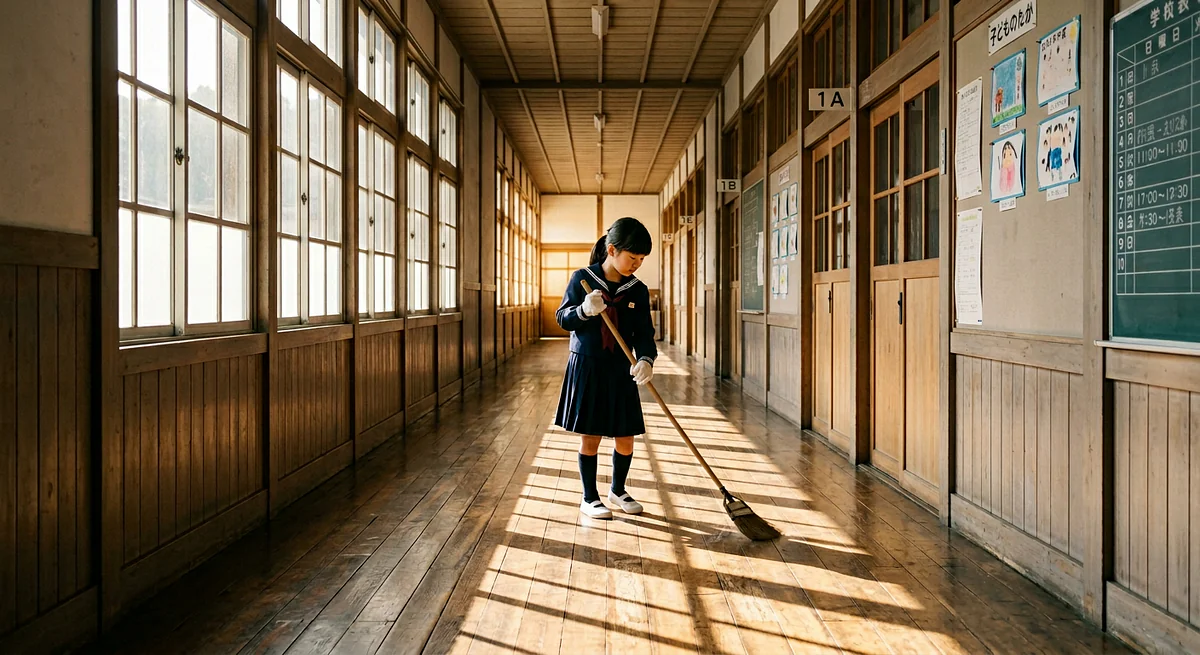
I asked my 7-year-old to clean his room last week. Twenty minutes of negotiation. Nobody tells Japanese children to respect their school. They clean it instead — floors, toilets, windows. Daily. Without being asked.
Shitsuke — Discipline as Embodied Practice
Shitsuke (躾) combines ‘body’ and ‘beautiful’: behavior embodied until instinct — owned, not enforced. It is the daily practice of wa (和) — harmony — absorbed before a child can name it.
Japanese parents rarely say ‘stop that.’ They say: ‘How do you think that made your friend feel?’ I rolled my eyes at this, too — then I tried it for a week. Gottman (1997) calls it emotional coaching — the single parenting behavior most predictive of resilience.
Lewis (1995) documented something remarkable. Japanese preschool teachers use the same language. The emotional coaching that starts at home extends into every classroom hour.
What Japanese Schools Do That Parents Don’t Have To
Every Japanese elementary school practices osoji — whole-school cleaning by students. No janitors. No exceptions. Tobin et al. (2009) found 87% of Japanese preschool teachers stepped back from peer conflict versus 31% of American teachers. Children build collectivism by resolving tension themselves.
Discipline without punishment is not a technique. It is a cultural infrastructure spanning home, school, and community.
The most transferable element: not osoji, not solo commuting — but the daily language of consequences.
But before you borrow any of it — you need to see the full picture.
HOW JAPANESE CHILDREN LEARN WITHOUT BEING TAUGHT
WHAT RESEARCH SAYS ABOUT THE JAPANESE PARENTING STYLE
I used to share Japanese parenting content online with the caption “Why can’t we do this?” Then I found the numbers nobody shares.
The Child Development Research That Surprised Me Most
Japanese parenting produces outcomes that researchers rank among the strongest globally — top 5 in PISA (OECD, 2022), stronger executive function, and higher prosocial behavior (Zahn-Waxler et al., 1996). Though it is worth noting: PISA scores may reflect Japan’s juku exam culture as much as its parenting philosophy.
Here is the one that stopped me. Heckman (2006), a Nobel laureate, found that early self-regulation predicts lifetime earnings and health better than IQ. Not test scores. Not early reading. Self-regulation. Heckman found the return exceeds 13% per year — higher than any financial market. Self-regulated children cost society less across their lives.
The Numbers That Complicate the Story
No admiring article mentions these costs:
1.46 million hikikomori — severe social withdrawal (Cabinet Office, 2023)
Child suicide leads causes of death for Japanese ages 10–14 (Ministry of Health, 2023)
70% of elementary students attend juku cram schools by age 10 (MEXT, 2021)
Despite the ikumen campaign since 2010, paternal childcare increased just 20 minutes per day over a decade (Tsutsui, 2022)
Within Japan’s collectivist framework — what psychologists call interdependent self-construal — emotional regulation strengths and shame-response risks share the same root (Kitayama et al., 2010). The culture that builds the world’s most self-regulated children also leads the G7 in child suicide.
That is not a contradiction. It is a warning.
WHAT RESEARCH SAYS ABOUT THE JAPANESE PARENTING STYLE
Japanese Parenting Style vs Western Parenting: Key Differences
Dimension
Japanese Approach
Western Approach
Early years
Maximum closeness — amae
Early independence training
Discipline
Shitsuke — embodied values
Rule-based compliance
School
Osoji — collective duty
Individual achievement
Outcomes
High self-regulation, PISA
Earlier self-expression
Risks
Hikikomori vulnerability
Anxiety, compliance issues
WHAT MOST ARTICLES NEVER TELL YOU ABOUT JAPANESE PARENTING
I almost didn’t include this section. Every article on the Japanese parenting style stopped before the hard part. I’m not going to.
The Shadow Side of Harmony
Japan’s collectivist parenting produces remarkable self-regulation — and one specific vulnerability. A child who only learns to belong never learns to recover from rejection.
Researcher Saito Tamaki (2013) reframes hikikomori: not laziness, not weakness — shame regulation collapse. When the group rejects a child shaped for belonging, they have no tools for recovery. Withdrawal is the only protection a nervous system without emotional vocabulary knows.
Schore (2003) found that unregulated shame physically alters prefrontal cortex development. That is the same brain region on which self-regulation depends. The greatest strength and the deepest vulnerability share the same address.
The Fix That Protects Emotional Resilience
Amae without emotional vocabulary produces connection-dependent children, not resilient ones (Gottman, 1997). The fix: pair closeness with words. Teach children to name feelings before the group requires silence — Gottman & DeClaire (1997) found this reduces behavioral problems by 35%.
A child who can say “I feel left out” can recover. A child taught only silence cannot.
WHAT MOST ARTICLES NEVER TELL YOU ABOUT JAPANESE PARENTING
WHAT WESTERN PARENTS CAN ACTUALLY BORROW
I spent three weeks trying to get my daughter to walk to the corner store alone. Wrong starting point. The most transferable part of Japanese parenting is not a practice. It is a posture.
Three Things Western Parents Can Borrow From Japanese Parenting Today
Kochanska (1994) found warmth-raised children internalize values willingly, complying at twice the rate of insecurely attached peers. Hart & Risley (1995) found that daily conversational quality predicts social competence more than income or education.
Three things any parent can start today:
Narrate impact, not rules. Instead of ‘stop grabbing,’ say ‘when you grab, your friend feels hurt.’ Empathy builds faster than fear.
Assign real responsibility from age 3. Genuine tasks — not toy chores — build intrinsic motivation (Deci & Ryan, 2000).
Model kodawari — devotion to craft. You don’t need a bento box. The child watching you redo something until it’s right is absorbing a standard. Bandura (1977) called it observational learning. Japanese parents call it Tuesday.
The three practices above — narrating impact, assigning real responsibility, and modeling craft — will feel familiar if you have explored the Montessori parenting style. Both approaches build intrinsic motivation the same way: through genuine contribution, not reward or punishment.
Here is what this looks like in practice: a child who cleans because they genuinely care about shared space behaves differently from a child who cleans to avoid punishment. Japanese parenting builds the first child. Most Western discipline systems build the second.
What Requires the Cultural Infrastructure
Solo commuting requires Japan’s safety infrastructure — 0.2 versus 6.3 homicides per 100,000 (UNODC, 2022). Osoji requires whole-school adoption. Neither travels.
The language does. Modeling behavior is free. It works faster than anything else you will try.
FREQUENTLY ASKED QUESTIONS
What is the Japanese parenting style called?
The Japanese parenting style is built on amae — Takeo Doi’s (1971) term for sanctioned emotional dependence that grows into genuine independence. I spent months thinking it was spoiling. It was foundation-building.
Why are Japanese children so independent?
Japanese children develop independence through sequence, not separation. Sroufe et al. (2005) found securely attached children became the most autonomous adults in a 30-year cohort. Skinship builds the nervous system that makes independence feel safe.
How do Japanese parents discipline without shouting?
Is Japanese parenting better than Western parenting?
Neither is superior. Japanese parenting produces exceptional self-regulation and PISA scores — and 1.46 million hikikomori (Cabinet Office, 2023). Kagitcibasi (2005) identified a better goal than either: the autonomous-relational child — securely connected and independently capable.
What can Western parents borrow today?
Western parents can start with three practices: narrate impact over rules, assign real responsibility from age 3, and model kodawari daily. Hart & Risley (1995) found that daily conversational quality predicts social competence more than any other parenting variable. Harder than expected. More effective than anything else I tried.
THE LESSON JAPANESE PARENTING ACTUALLY TEACHES
I still bribe my kids. Last Tuesday — screen time. But I know the sequence now. Presence first. Independence second. Amae before autonomy.
You cannot transplant Tokyo into your living room. But Van IJzendoorn & Sagi (1999) reviewed 32 cultures and found the same result in every one: secure attachment predicts healthy independence. This was never about Japan. It was always about children.
The bento box, the subway commute, the spotless school — these are what security looks like once it has been built. They are the evidence, not the method.
The most important thing the Japanese parenting style teaches is not a technique. It is a direction: toward the child first. Build it first. Everything else follows.
My daughter was seven when her teacher called her “too sensitive.” She cried when friends argued. She needed reassurance — and I gave it, every time, and worried every time I did. Every parenting book on my shelf whispered the same quiet fear — was I raising someone who couldn’t cope?
Then I found the research. And everything reframed.
One in five children in the United States now carries a diagnosed mental health condition (CDC, 2021). Childhood anxiety diagnoses rose 18% between 2020 and 2023 alone (Annie E. Casey Foundation, 2024). Yet most parenting advice ignores the one thing research identifies as most protective: emotional security.
The strongest protection against childhood anxiety is not tutoring, not discipline, not structured activities. It is a parent who responds to their child’s feelings (Murray et al., 2012).
Elephant parenting style changes that priority entirely.
Fifty years of attachment science confirms this approach builds genuinely independent children. The parent who stays emotionally available is not soft. They are the ones the research keeps pointing to (Groh et al., 2023).
Emotional security is not what elephant parenting produces. It is what makes everything else possible.
The feelings your child brings to you are not problems. They are invitations — and words of encouragement for mothers who gave reassurance every time: the research was always on your side.
Elephant Parenting Style: What Attachment Science Says About Raising Emotionally Secure, Independent Kids
WHAT IS ELEPHANT PARENTING? (The Definition No One Gives Completely)
So what does that actually mean in practice?
The elephant parenting style is raising your child with emotional security as the foundation. Not a reward for good behavior. A constant they never have to earn.
Where It Comes From
Priyanka Sharma-Sindhar named it in a 2014 Atlantic essay — a counter to Amy Chua’s tiger parenting movement. Cross-cultural research across eight nations confirms that warm, responsive caregiving predicts the same developmental outcomes regardless of culture (van IJzendoorn and Sagi, 1999). Western parenting is the only tradition that treats emotional closeness as a risk. Everywhere else, it is simply called raising children (Lancy, 2022).
How It Differs
Most comparisons between parenting styles are label contests. This one is not.
Tiger parenting and elephant parenting are not opposite intensities of the same thing. Tiger parenting builds a child who performs for external approval. Elephant parenting builds a child who performs because they want to.
Helicopter parenting and elephant parenting are the most commonly confused. Both look like attentive parenting from the outside. The difference is what the parent is protecting. Helicopter parents protect the child from difficulty. Elephant parents protect their child’s capacity to face it.
Gentle parenting and elephant parenting share values but have different starting points. Gentle parenting begins with the child’s right to autonomy. Elephant parenting begins with the question: Can this child feel safe enough to use that autonomy? Safety comes first. Autonomy follows (Bowlby, 1969).
Permissive parenting — warmth without structure; elephant parents provide both.
Montessori parenting style and elephant parenting share the same belief: a child learns best from a responsive, nurturing presence — not a parent who fixes everything. Diana Baumrind proved it in 1966: warmth plus boundaries produces the strongest child outcomes (Baumrind, 1966). Fifty years of research have not changed it. Children do not need a parent who fixes everything — they need a responsive, nurturing presence (Ainsworth, 1978).
WHAT IS ELEPHANT PARENTING? (The Definition No One Gives Completely)
THE SCIENCE BEHIND ELEPHANT PARENTING STYLE — WHY IT ACTUALLY WORKS
I used to think staying calm during my son’s meltdowns was just good manners. Then I learned it was neuroscience.
What Harvard Found
Harvard’s Center on the Developing Child (2024) confirms that serve-and-return interactions physically build a child’s brain. Without them, the stress response system wires for threat, not learning. MRI scans link maternal sensitivity to hippocampal volume, which governs emotional regulation (Rifkin-Graboi et al., 2022).
What Gottman Proved
One variable predicts child outcomes more powerfully than discipline or academics: a parent’s meta-emotion philosophy (Gottman, Katz, and Hooven, 1996).
Emotion-coached children showed:
Higher vagal tone — meaning they recover from upsets faster
Stronger emotional intelligence and self-regulation
Fewer anxiety-related problems, physical and behavioral
Neuroscientist Allan Schore confirmed this is literal. A calm parent’s right brain directly regulates their child’s right brain through attunement (Schore, 2001).
The Repair Principle
Staying calm during a meltdown is not just kindness. It is infrastructure. The stress system built now is the one they carry forever.
Parents who repair misattunement raise equally secure children (Harvard CDChild, 2024). Repair builds resilience — not perfection. Coming back is what transforms you from just a parent into your child’s safe haven.
THE SCIENCE BEHIND ELEPHANT PARENTING STYLE — WHY IT ACTUALLY WORKS
WHAT ELEPHANT PARENTING STYLE GETS RIGHT (And What Research Confirms)
When my son was four, he climbed the highest slide at the park. The one that made my stomach drop. He looked back once. I nodded. He went.
That is the secure base.
The Independence Paradox
Independence is not the goal of elephant parenting. It is the byproduct. A child whose emotional bids are consistently met stops needing the parent to be nearby — because they carry the security with them.
A 2024 Frontiers in Psychology study confirmed parental warmth directly predicts self-efficacy, school readiness, and independent exploration (Liu et al., 2024). Securely attached children venture further — because they trust someone is there when they return (Ainsworth, 1978).
The Emotional Intelligence Advantage
In studies covering 6,800 children, emotion-coached kids show stronger academic performance and healthier relationships (Groh et al., 2023). These children also show greater grit (Duckworth et al., 2007). Gottman found 35% fewer behavioral problems and stronger peer relationships in these children (Gottman, 1997). Emotional security is not the alternative to achievement — it is the architecture of it (Groh et al., 2023).
Research Insight
The Benefits Last a Lifetime
85
years of Harvard data — the longest-running happiness study ever conducted
“The warmth of childhood relationships predicts adult flourishing above wealth, career, or status.” (Waldinger & Schulz, 2023)
WHAT MOST ARTICLES NEVER TELL YOU ABOUT ELEPHANT PARENTING
Every response you give to your child’s emotional cues is measurable. Every response to your child’s emotional cue physically shapes their brain. This is not a metaphor — a parent’s responsiveness appears as a physical measurement in their child’s brain (Rifkin-Graboi et al., 2022).
Elephant parenting style is not a philosophical preference. It is a neurological decision.
Every time you stay calm or name a feeling, you are building something permanent.
Children raised without responsiveness show amygdala hyperactivation — the brain in a permanent threat-state (Tottenham et al., 2011). You cannot choose whether to shape your child’s brain. You are already doing it. Childhood anxiety rose 18% in three years (Annie E. Casey, 2024) — and dismissive parenting drives the risk (Murray et al., 2012).
WHAT MOST ARTICLES NEVER TELL YOU ABOUT ELEPHANT PARENTING
THE 3 PITFALLS THAT TURN ELEPHANT PARENTING INTO HELICOPTER PARENTING
I thought I was being present. My son would struggle with something — a puzzle, a friendship, a hard feeling — and I would move in immediately. Every time. What I called attunement was actually anxiety. Mine.
Pitfall 1 — Validating vs. Managing
Elephant parenting style means witnessing discomfort — not eliminating it. When you remove every source of struggle, the support becomes the trap. Overprotective parenting specifically predicts anxiety disorders in children, independent of parental anxiety (Bayer et al., 2006; Rapee, 2009). Validate feelings. Struggle builds grit.
Pitfall 2 — Scaffolding vs. Solving
The attuned parent asks questions. The drifting parent fixes. Harvard confirms children build stronger executive function when given space to attempt first (Harvard Center on the Developing Child, 2024). The test: if your child has not attempted it independently, your help arrived too early. Children rescued from difficulty never learn that difficulty ends — only that you will end it.
Pitfall 3 — Whose Discomfort Is This?
When you were not comforted as a child, you either dismiss or smother. Intergenerational transmission research calls this unconscious overcorrection — co-regulation becoming enmeshment (Siegel and Hartzell, 2003). Here is what no other article will tell you. If you cannot sit with your child’s distress, you are not helping them. You are helping yourself.
The Pitfall Nobody Names
When one parent validates, and the other dismisses, something damaging happens. Children learn to perform emotions — reading the room before deciding how to feel. Gottman’s research confirms that parenting consistency between caregivers predicts child outcomes more reliably than either parent’s individual style (Gottman, 1997). That is not emotional security. That is emotional management — and no amount of individual attunement fixes it.
HOW TO PRACTICE ELEPHANT PARENTING IN REAL MOMENTS (Word-for-Word)
Last Tuesday at bedtime, my son said, “Nobody likes me.” I know that sentence. Every parent knows it. My instinct was to list his friends. I caught myself. The default response is not unkind. It just closes the door at the exact moment he needed it open.
Script 1 — When Your Child Fails Default: “You’ll do better next time.” Better: “That really stings. You worked hard, and it didn’t go the way you wanted. What felt hardest?” Naming the emotion opens the prefrontal cortex first.
Script 2 — When Big Feelings Arrive Default: “Calm down, it’s not a big deal.” Try this: “Something big is happening for you. I’m right here. Take your time.” Your calm nervous system regulates theirs (Siegel, 2012). Stay present. Do not check your phone.
Script 3 — When They Say Nobody Likes Me Default: “That’s not true — you have lots of friends.” What works: “Being left out is one of the hardest feelings. Tell me what happened.” Validation before correction produces measurably better outcomes than correction alone (Gottman, 1997).
Research Insight
Why Words Are the Most Powerful Parenting Tool
Naming your child’s emotion aloud does something measurable. Psychological Science found labeling emotions reduces amygdala activation more effectively than distraction or reassurance (Lieberman et al., 2007).
“Words do not just soothe children. They physically regulate them.”
Gottman confirmed that children acquire emotional vocabulary through modeling, not instruction (Gottman, 1997). Rehearse before you need them — because in the moment, you will default to what you know. Say “I’m frustrated, so I’m going to breathe” out loud in front of your child. They learn this language by hearing it, not being taught it.
The parent who has practiced responds — instead of reacts.
A pediatrician once told me my son was “too attached.” I went home and read every study. If you rush to comfort, struggle to let your child face difficulty alone, and choose feelings over grades, you are already doing this.
Does elephant parenting spoil children?
That question gets the psychology backwards. Spoiled children are not children who received too much comfort — they are children whose parents could not tolerate their discomfort. Securely attached children hear “no” better and recover from disappointment faster, because comfort and limits come from the same trusted source (Groh et al., 2023).
Does science back it?
Three independent bodies of research all reach the same conclusion. Attachment theory, Harvard’s serve and return work, and Gottman’s coaching studies agree: warm, responsive caregiving predicts outcomes more reliably than income, discipline, or academic pressure (Gottman et al., 1996).
How is it different from helicopter parenting?
Helicopter parenting is overprotective — managing the environment to prevent all difficulties. This approach supports the emotional experience of difficulty. One removes struggle. The other builds the capacity to face it.
Does it work for every child?
Mostly. Elaine Aron’s research found sensitive children — 15–20% of the population — show far stronger outcomes under emotionally attuned parenting (Aron, 1996). Less sensitive children need identical warmth with more space for independence.
What if my partner’sparents differ?
Start with one shared script — consistency matters more than perfection. Consistency between caregivers predicts outcomes more reliably than either parent’s individual style (Gottman, 1997).
Is gentle parenting the same?
Related but distinct. Gentle parenting builds autonomy. Elephant parenting establishes the emotional safety that makes autonomy possible (Bowlby, 1969).
CONCLUSION
My son is nine now. Last week, he came home upset, sat beside me, and said nothing for ten minutes. Then: “I just needed to know you were there.”
That is the entire philosophy.
Elephant parenting style is not a trend. It is responsive parenting that fifty years of science has always described — and finally named. Presence, warmth, and repair — those are the three things every parent-child relationship is built from (Bowlby, 1969).
85 years of data confirm warmth predicts adult flourishing above wealth or status (Waldinger and Schulz, 2023).
The secure base your child needs is not a special skill. It is you — consistently showing up. He knew he could ask. That is the whole point.
Elephant parenting style builds emotional security, resilience, and genuine independence — and every decade of research confirms it. Not despite the warmth. Because of it.
It was 7:14 on a Tuesday morning when I realized I had been doing everything wrong — and the evidence had been in my kitchen the whole time.
My four-year-old wanted to pour her own cereal. I said yes — then grabbed the box when she tilted it too far. She burst into tears. Not because of the spilled cereal. Because I took over. Again.
A 32-year study in the Proceedings of the National Academy of Sciences followed 1,000 children from birth to adulthood. Childhood self-control — not IQ, not family income, not school performance — predicted adult health, wealth, and wellbeing more powerfully than any other factor. The researchers called it the single most consequential variable in human development — and the Montessori parenting style was built to develop exactly that.
The Montessori parenting style — a child-centered, evidence-based philosophy rooted in Dr. Maria Montessori’s century of direct observation — was specifically designed to build exactly that capacity. Not through pressure or reward charts. Through freedom within limits — a respectful parenting approach that treats your child’s drive toward independence as a neurological gift rather than a behavioral problem.
What separates this guide from everything else you will read is one concept most Montessori articles never explain: sensitive periods. These are time-limited neurological windows during which your child absorbs specific skills through child-led learning and hands-on learning with an ease that will never come this naturally again.
Your child is in one right now.
Miss it, and it is gone. Protect it, and it compounds for a lifetime.
Montessori parenting style
The Five Core Principles of Montessori Parentingstyle
The parent who stops interrupting their child more than they redirect them will see a different child within two weeks. I know because I was the parent who could not stop interrupting.
My son turned two and a half, and putting on one shoe started taking longer than filing my taxes. What I did not understand then: he was not being difficult. He was being developmental. Every frustrated grab, every “let me do it myself” — all of it was neurologically purposeful. His brain was building executive function one refused piece of help at a time.
These five principles are not abstract philosophy. They are the map I wish someone had handed me at 8:17am.
Observation — Watch Before You React Watch ten seconds before intervening. Ask what the behavior is communicating before asking how to stop it. Parental observation practiced as an active skill — not passive waiting — is the single highest-leverage shift in this entire framework.
Freedom Within Limits — The River Needs Banks Real choices within non-negotiable boundaries. Two outfit options, not unlimited ones. The limit is the riverbank. The freedom is the river. Both are essential. Children given structured choice show stronger self-regulation than children given either total freedom or none — a finding consistent across autonomy-supportive parenting research. Two options is not a restriction. It is a gift your child’s developing brain is not yet equipped to refuse.
The Prepared Environment — Function Over AestheticsPractical life activities — cooking, pouring, folding — build more intrinsic motivation than any purchased curriculum. The prepared home environment was never about aesthetics. It was about making independence physically possible before you ask for it emotionally.
Respect — A Behavior, Not a Feeling “You are working so hard on those socks,” before “we have to go.” Effort acknowledged before the timeline. Acknowledging effort before redirecting activates cooperation rather than defensive shutdown — a neurological shift that takes three seconds and costs nothing.
Follow the Child — Trust the Obsession. My daughter ignored letters at three and a half. She arranged rocks by size for weeks instead. She was in an active sensitive period for order within her planes of development. At four and a half, she was reading within eight weeks of showing interest.
Her obsession was not a detour from development. It was development.
The reason these principles work is not philosophical. It is neurological — and your child’s brain is the proof.
Core Principles of Montessori Parentingstyle
Sensitive Periods in Montessori Parenting Style — The Windows Your Child Has Right Now
Your child’s brain will never again learn anything the way it is learning right now.
My son was eighteen months old when he became obsessed with closing doors. Every door. Every cabinet. Every drawer. If I opened one before he could close it himself, the meltdown was immediate and total.
His pediatrician smiled and said, “He is in a sensitive period for order. This is exactly right.”
I stopped fighting his behavior. I started reading it instead.
What Are Sensitive Periods? The Neuroscience Behind Effortless Learning
Sensitive periods are neurologically driven windows during which a child’s brain is specifically primed to absorb certain skills with effortless ease. This process is powered by what Montessori called the absorbent mind — the unconscious learning capacity children carry from birth to age six.
Neuroscientist Patricia Kuhl at the University of Washington confirmed this directly. Between six and twelve months, infants’ brains measurably narrow their sensitivity to non-native speech sounds. That window closes permanently.
A child raised bilingual during this window picks up both languages the way they pick up walking — no lessons, no flashcards, no effort required. Every adult who has struggled through Duolingo for three years and still cannot order coffee abroad knows exactly what closes when this window shuts. Neural plasticity is highest during these windows and consolidates irreversibly as each sensitive period completes.
When the window closes, the skill can still be learned — but it requires conscious effort rather than effortless absorption. The difference between a child learning to walk and an adult learning to tightrope walk. These are the words of encouragement for mothers — the window is open, and you are here.
The Six Montessori Sensitive Periods — What They Look Like in Your Home
Understanding your child’s planes of development means recognizing which window is open right now:
Language(birth–6 years) — The child narrating everything and demanding the same book nightly is in peak acquisition mode. Every word absorbed now builds the foundation for every communication skill they will carry for life.
Sensitive period for order(18 months–3.5 years) — The toddler melting down over triangles instead of squares is not defiant. Their brains are building the organizational architecture that later supports logical thinking.
Sensory Refinement (birth–5 years) — Real cooking, gardening, and water play are developmentally appropriate neurological investments. Screen time during this window displaces the hands-on sensory input the brain is specifically seeking.
Movement (birth–5 years) — Movement is not a break from learning at this stage. It is the mechanism of learning. Sitting still actively works against development.
Small Objects (1–4 years) — Fine motor neural plasticity in real time. Provide safe small objects rather than removing them all.
Social Behavior(2.5–6 years) — Grace and courtesy lessons land permanently during this window. Model the behavior. They are absorbing everything they witness.
If none of these describes your child right now, they are between active windows. The intensity passes. The capacity it built does not.
Why Sensitive Periods Shape Adult Wellbeing — The Research Parents Need
Sensitive periods are not stages you survive. They are invitations you either accept or miss.
A 2025 study in Frontiers in Developmental Psychology by Lillard, Jiang, and Tong found that Montessori education during sensitive periods produces measurably higher adult well-being — not just stronger childhood outcomes, but higher happiness, meaning, and self-confidence measured in adulthood.
My son is six. The door-closing stopped. The internal sense of order it built — his comfort with systems, his ease with routines — stayed.
The Montessori parenting style does not ask you to understand developmental theory. It asks you to trust what you are watching — and to get out of the way. That is harder than it sounds. It turns out most of us were never taught to watch.
Sensitive Periods in Montessori Parenting Style
The Neuroscience — Why Montessori Parenting Works in Your Child’s Brain
Nobody designed the Montessori parenting style around brain science. Maria Montessori designed it around children, and the brain science arrived sixty years later to confirm she had been right about everything.
What Is Actually Happening Inside Your Child’s Brain
The prefrontal cortex — responsible for executive function development, impulse control, and self-regulation — develops most rapidly between ages three and six. This is precisely the window Montessori parenting style was built around, decades before brain imaging confirmed it.
Every time your child sustains an uninterrupted work period and transitions independently, they are exercising the prefrontal cortex the way an athlete exercises a muscle in the gym. Interrupt the work period and the same thing happens neurologically as skipping the workout.
The Harvard Center on the Developing Child calls this the brain’s “air traffic control system.” Serve-and-return interactions — observation followed by responsive child-led guidance — directly support the development of executive function infrastructure that children carry into every challenge that follows.
Hands-on learning accelerates this further. When a child physically manipulates objects, their brain activates two pathways at once — sensorimotor and cognitive. This dual-channel process creates memory consolidation that verbal instruction alone cannot replicate. This is why a child who pours water remembers. A child who watches someone pour water forgets. Parent with grace — and the child carries that into every challenge that follows.
What PNAS Research Shows About Montessori and Executive Function
Angeline Lillard at the University of Virginia led the first national RCT of public Montessori preschool, published in PNAS (2025) — 588 children, 24 schools, ages three through kindergarten. Montessori children showed significantly stronger reading, memory, executive function, and social understanding.
Moffitt et al., PNAS (2011), followed 1,000 children to age 32. Childhood self-control predicted adult health, wealth, and relationships more powerfully than IQ or social class combined — independently of both.
The child practicing self-regulation at your kitchen table at four is not just learning to wait. They are building the neural architecture that will determine the quality of their adult life.
Why the Sticker Matters Neurologically
Intrinsic motivation and extrinsic motivation do not simply feel different. They activate competing reward pathways — and only one survives removal of the reward.
Edward Deci and Richard Ryan’s Self-Determination Theory established that autonomy, competence, and relatedness generate genuine, lasting motivation. Montessori satisfies all three: the child chooses their activity (autonomy), completes it without rescue (competence), and works alongside others in a prepared community (relatedness).
When you resist the reward chart — and your mother-in-law is standing right there suggesting you just give the sticker — you are not being rigid. You are protecting a neural pathway the sticker would gradually dismantle. The Harvard Center on the Developing Child identifies this intrinsic motivation pathway as the foundation of holistic development — the evidence-based case for trusting a child to want to learn without being paid to do it.
The Neuroscience — Why Montessori Parenting Works in Your Child’s Brain
How to Practice Montessori Parenting at Home — A Real Daily Guide
The Montessori home does not look different. It functions differently — and the difference is invisible until you see a three-year-old carry a bowl of cereal to the table with the focused dignity of someone who has never needed help.
She got thirty percent in the bowl. She ate every single piece. Then looked up at me with an expression I had never seen at breakfast before. These are the giveaways — what this mom foundat breakfast.
This is mastery — not the performance of competence, but the private experience of it. Children who regularly access mastery through practical life activities develop a self-concept built on capability rather than approval. That distinction follows them for life.
Three Home Changes That Cost Nothing and Build Real Independence
Before buying anything, change three things that cost nothing:
Lower one hook — they hang their own coat without asking, eliminating one daily negotiation permanently
Clear one low shelf in the kitchen — accessible snacks, they serve themselves, build genuine parental observation data about what your child can already do independently
Add a one-step stool at the sink — handwashing becomes their responsibility, not your reminder
When you prepare the environment this way, your kitchen becomes your most powerful prepared home environment. Real food, real tools, real contribution — this is practical life activities in its truest form. Children are not requesting responsibility. They are neurologically ready for it months before most parents recognize the signal.
The Real Montessori Morning
7:00am — The daily routine actually begins the night before, when nobody is tired and nobody is late. Clothes chosen from two options your child picked themselves. It costs forty-five seconds the night before. It buys eleven minutes of independence the next morning.
7:20am — They pour. Something spills. A cloth lives in the same spot every day. They clean it. You understand for the first time why developmentally appropriate challenges matter more than clean floors.
7:45am — Twenty minutes of uninterrupted work period. One activity. You observe the child without redirecting. The most child-centered investment of twenty minutes available to any parent on any schedule.
8:15am — “We leave in five minutes.” Always five. Never zero. Follow the child’s need for transition time and a battle that used to take fifteen minutes disappears entirely. The five-minute warning is not a parenting trick. It is respect made practical.
The NICHD Study confirmed: quality of parent-child interaction predicts outcomes far more powerfully than quantity of time. Forty intentional minutes outperforms a distracted full day.
The child who pours her own cereal at three is the child who packs her own bag at six — without anyone asking. You are not doing less. You are building more.
How to Practice Montessori Parenting at Home — A Real Daily Guide
Montessori Discipline — What It Is, What It Isn’t, and What to Actually Say
The night my son threw his dinner plate on the floor and held eye contact with me while doing it, I understood something I had been reading about for months but had not yet felt in my body: he was not challenging my authority. He was showing me his limit — the only way a three-year-old can.
The plate was the only sentence he knew how to form.
What Montessori Discipline Actually Is
The Montessori parenting style treats every behavioral incident as information first. Not “how do I stop this” but “what is this telling me.“
That single reframe changes everything — not just how you respond, but how dysregulated behavior feels. It shifts from personal attack to developmental communication, you are learning to translate.
This aligns with Diana Baumrind’s authoritative parenting — high warmth combined with high structure. A 2023 systematic review of 32 studies in Campbell Systematic Reviews confirmed this approach produces significantly stronger self-regulation and emotional regulation than conventional discipline. The same review found that children in authoritative environments showed stronger social competence at five, eight, and twelve years — the effect does not fade.
Self-regulation is the goal. Not compliance. A child who builds the internal capacity to choose differently — eventually, nonlinearly, slowly.
My son took fourteen months. Not two weeks. Not one impressive dinner party. Fourteen months — including three weeks in month nine, where I was genuinely convinced I had broken something. Every article made it sound faster. It is slow and involves regression at the worst possible moments.
It works anyway.
Three mechanisms — and only one of them requires anything from you in the moment:
Natural consequences work because they are not invented by you. The paint dries on the brush your child left uncapped. The tower falls when it is built too fast. No lecture required — the environment teaches what you cannot. This is not permissiveness. It is precision.
Model grace and courtesy— but understand what modeling actually means neurologically. Your child is not watching what you say when they misbehave. They are watching what your face does. What your voice does. Whether you stay or leave. The parent who breathes through their own frustration is doing more developmental work than any time-out ever achieved.
Observe before responding— ten seconds before anything. I set a phone timer for three months because at 6pm my principles evaporated without a mechanical reminder. The timer is not a trick. It is the gap between reaction and response. That gap is where Montessori discipline actually lives.
Montessori Discipline — What It Is, What It Isn’t, and What to Actually Say
What Montessori Discipline Is Not — The Line Parents Keep Crossing
Freedom within limits means the limit does not move. Not when your child cries. Not when they escalate. Not when it is 6 pm, and the path of least resistance is right there.
The night of the plate: dinner finished, floor cleaned together, sat quietly until both of us were regulated. No timeout. No negotiation. No abandonment.
That sitting together — regulated adult, dysregulated child — is what positive discipline looks like in a real kitchen on a real evening. Jane Nelsen identified the mechanism precisely: children do not behave better when they feel worse. They behave better when they feel genuinely connected and capable of doing differently.
What to Actually Say
Situation
Reactive
Montessori
Refuses shoes
“Dinner is over.”
“Three minutes. Sneakers or boots?”
Hits sibling
“Say sorry.”
“Food stays on the table. Let’s clean together.”
Won’t clean up
“No screen time”
“The shelf needs the blocks back. Need a hand?”
Throws food
“Stop crying.”
“You’re frustrated. Breathe with me first.”
Full meltdown
“Hitting hurts. Let’s find another way.”
“You’re frustrated. Breathe with me first”
Last week, my son spilled his juice, looked at me, and said, “I’ll get the cloth.”
He did not ask. He did not wait. He just went and got it.
Fourteen months of imperfect practice. One Montessori guide said, “You are not failing. You are in the middle.”
Keep going.
The Part Nobody Talks About — Montessori Parenting Style’s Hardest Skill
The hardest part of the Montessori parenting style has nothing to do with your child. It has everything to do with what happens in your body when you watch them struggle and do not intervene.
My four-year-old was folding a towel. Eleven minutes in, it looked like it had survived something. My hands were twitching. My jaw was tight. I was doing the silent calculation every parent knows — subtracting what I was watching from what I had imagined it would look like, arriving at a number that made my hands twitch.
My daughter was completely calm. I was the one who was not.
Dr. Maria Montessori called this adult self-preparation — the inner work required before any external technique becomes genuinely available to you. She was not being philosophical. She was being precise.
A parent who cannot regulate their own nervous system cannot accurately observe the child. They cannot scaffold independence without anxiety leaking through every interaction. They cannot hold the unhurried space that child-led learning requires.
Dan Siegel confirmed this neurologically: co-regulation — a parent’s regulated nervous system actively settling their child’s developing one — is not a metaphor. It is a measurable biological process. In the Montessori parenting style, your internal state is the parenting environment. A 2019 study in Mindfulness confirmed that parents practicing mindful self-regulation reported substantially less reactive parenting and significantly higher parental sensitivity — the precise capacity this approach demands most.
Three Prerequisites — Not Suggestions
Pause two seconds before every intervention. Ask one question: Does my child need this, or do I need to give it? Different needs. Different answers.
Name your triggers before they name you. A trigger you identified calmly is one you can prepare for rather than react to.
Separate process from outcome. The towel does not need to look like a towel. It needs to have been folded by your child.
My daughter folded that towel imperfectly for two weeks. Then one morning it looked like a towel. A month later, she was folding her own laundry and teaching her younger brother how.
Everything was developing. I just could not see it yet.
You cannot consistently give your child what you have not yet developed in yourself. Self-regulation in the Montessori parenting style is not one technique among many. It is the ground everything else grows from, and the towel moment is where you find out whether you have built it.
The Part Nobody Talks About — Montessori Parenting Style’s Hardest Skill
Montessori vs. Gentle Parenting — The Comparison Parents Actually Need
Two parents using different frameworks can raise equally thriving children — and still be missing half the picture.
My sister does gentle parenting. I do Montessori. We have had the same argument eleven times. Both of our children are doing genuinely well.
Both belong to the same family of respectful parenting — built on empathy, intrinsic motivation over external rewards, and Diana Baumrind’s authoritative parenting framework. A 2023 systematic review of 32 studies in Campbell Systematic Reviews confirmed this combination produces significantly stronger self-regulation and social cognition across every demographic studied. The research does not distinguish between gentle parenting and Montessori. Both produce the outcome. The paths differ.
Montessori parenting style differs from gentle parenting in one fundamental way.
Gentle parenting asks: how do I respond to my child emotionally right now?
Montessori parenting style asks: what environment do I create, which sensitive periods do I recognize, and how do I scaffold independence before dysregulation begins?
Last November my nephew had his third transition meltdown at the same dinner moment. My sister handled each one with extraordinary patience — and looked exhausted by the third. I watched and thought: he does not have a regulation problem. He has a transition problem. A transition problem is a prepared home environment problem — and it is solvable before dinner, not during it.
I told her about five-minute warnings and the sensitive period for orders.
She said: “Why has nobody told me this before?”
Gentle parenting is your relational language. The Montessori parenting style is your developmental framework. Use one, and you are equipped. Use both, and you are fluent in the full conversation your child is trying to have with you.
Montessori parenting FAQS
Can I practice Montessori parenting if my child attends a traditional school?
Yes — completely. The Montessori parenting style lives at home independently of school. Your prepared home environment, parental observation practice, and freedom within limits apply every evening. What happens in your home between 4pm and bedtime shapes development more than most parents realize.
At what age should I start?
Birth. The absorbent mind operates from birth to age six — making the first plane of development the highest concentration of sensitive period activity in a child’s entire lifetime. Earlier genuinely matters. But parents who start at three, five, or eight still report meaningful shifts in cooperation, independence, and connection within weeks.
Do I need expensive materials?
No. Maria Montessori’s original children had no purchased materials. Practical life activities — cooking, pouring, folding, cleaning — are the original Montessori curriculum. The most Montessori object in your home is a step stool at the kitchen sink.
Is Montessori parenting suitable for strong-willed or neurodivergent children?
Often exceptionally well-suited. Montessori’s movement integration, sensory engagement, and child-led learning naturally accommodate children with ADHD and sensory processing differences — because the framework was built around following the child’s neurological lead, not overriding it. Freedom within limits reduces power struggles by eliminating the conditions that produce them.
What if my partner does not support the Montessori parenting style?
Start with shared values, not terminology. My husband’s turning point was not a philosophy — it was a midnight screenshot of a PNAS study. Most partners respond to outcomes before they respond to labels. One principle. One data point. One Tuesday morning at a time.
How long before I see results?
Calmer routines and fewer power struggles appear within weeks. The deeper outcomes — executive function, self-regulation, emotional regulation — compound over years. A 2025 PNAS study found the effects strengthened as children aged. You will not see everything that is developing. That does not mean nothing is developing.
The Investment You Are Making Every Day
Here is what thirty-two years of following 1,000 children from birth to adulthood found: childhood self-regulation — not IQ, not family income, not school performance — predicted adult health, wealth, and wellbeing more powerfully than any other variable the researchers measured.
Not curriculum. Not test scores.
The quiet, daily, unglamorous practice of building self-regulation in a child who is still learning how.
That is what the Montessori parenting style is actually doing every morning you wait while the cereal spills. Every limit you hold without negotiating. Every sensitive period you protect that nobody else in the room recognizes as the neurological investment it is.
The evidence is unambiguous. Angeline Lillard’s 2025 PNAS national RCT confirmed it across 588 children in 24 public schools. Moffitt et al.’s 32-year longitudinal study confirmed it across a lifetime. The Harvard Center on the Developing Child confirmed it across decades of brain research. A child-centered environment built around hands-on learning, child-led learning, and genuine intrinsic motivation produces measurable results. Executive function, emotional regulation, social cognition, and emotional intelligence — these are the holistic development outcomes that predict flourishing across an entire life.
This is not a philosophy you have to believe in.
It is a body of evidence you can trust.
Tomorrow morning — one thing. Not three. One.
Find the sensitive period your child is in right now — the obsession, the phase, the behavior you have been managing instead of reading. Name it. Protect it for one week without intervening.
That is it. That is the whole practice.
The hook, the shelf, the step stool can wait. The work period can wait. The five-minute warning can wait. The window your child is in right now cannot.
The child who pours their own cereal at three is the child who navigates their own life at twenty-five. With the quiet confidence of someone trusted with real things since the beginning.
That confidence was not given to them.
It was built — by you, in your kitchen, on a Tuesday, with a cereal box and four paper towels and the hardest Montessori parenting style skill there is.
Being a mother transforms you into something extraordinary – a human being capable of enduring the hardest moments while finding strength you never knew existed. The journey of motherhood doesn’t come with a manual, yet mothers instinctively navigate through sleepless nights, endless diaper changes, and the overwhelming responsibility of raising children who depend entirely on their love and care.
When days feel tough and you’re questioning whether you’re doing enough, remember that words of encouragement for mothers remind us that every small victory – from getting everyone dressed and out the door on time to finally seeing your baby sleep through the night – represents incredible progress in this life-changing adventure. The greatest force on earth isn’t found in nature but in a mother’s heart when she faces challenges that seem impossible to overcome.
Words of encouragement for mothers acknowledge that motherhood makes you literally invincible, even when you feel like you’re drowning in chaos. Whether you’re a first-time mom feeling uncertain about every decision or an experienced mother balancing multiple responsibilities, including navigating toxic co-parenting quotes and difficult relationships, the truth remains that you’re stronger than you realize and capable of handling whatever comes your way. Your children may not always show it, but they appreciate you more than you know – you’re their safe place in a world that can feel scary and unpredictable.
Words of Encouragement for Mothers
Words of encouragement for Mothers transform women into beings of extraordinary resilience, where each day brings new challenges that test their strength in ways you never imagined. When you’re feeling overwhelmed by the endless responsibilities of raising kids, remember that every mother before you has navigated these same turbulent waters.
The emotional toll of parenting often leaves you discouraged, questioning whether you’re doing enough, but the truth is that your unwavering love creates the foundation upon which your children will build their entire lives. Your baby’s first smile, those quiet moments during a midnight feeding, the terrifying realization that this tiny human depends entirely on you – these experiences shape you into someone capable of weathering any storm.
The journey of motherhood isn’t about perfection; it’s about showing up every single day, even when you feel tired beyond measure. Whether you’re a first-time mom learning to balance work and childcare, or navigating the postpartum period where your body feels foreign and your emotions run raw, you’re strong enough to overcome whatever obstacles appear.
Your instincts guide you through sleepless nights and tantrum-filled afternoons, teaching you that being a good mom doesn’t mean having all the answers – it means trusting yourself to learn and adapt. Parent with grace. The special bond between mother and child grows stronger through these trials, creating an unconditional connection that will last an eternity. You’re not just surviving motherhood; you’re becoming the woman your children need you to be.
Words of Encouragement for Mothers
Empowering Quotes for Strong Mothers
“The essence of motherhood isn’t found in picture-perfect moments, but in the raw beauty of your postpartum journey.” When your body feels foreign after creating life, remember: “You’ve performed the ultimate miracle – bringing a soul into existence through courage most will never know.”
Those sleepless nights nursing your newborn, questioning if you’re enough, need this truth: “Strength isn’t measured by perfection, but by showing up overwhelmed and choosing love anyway.” The profound transformation happening within you goes deeper than physical changes – “You’re becoming someone who can embrace chaos while finding grace in the messy reality of raising children.
” Trust this: “Every tear, every moment of doubt, every challenging day is growth disguised as struggle.” “Your spiritual initiation through pregnancy and birth has changed your very essence in ways words cannot capture.”
When anxieties about childcare, housework, and maintaining your identity feel heavy, hold onto this: “Countless women before you have walked this path and emerged stronger, wiser, and more resilient.”
The emotional labor of motherhood – the constant decision-making, the responsibility for another human’s wellbeing – deserves recognition: “You’re not just surviving the demands of parenting; you’re thriving in a role that requires infinite determination.”
Crunchy parenting. Remember this truth: “Every difficult day proves your power to overcome obstacles and continue moving forward with unwavering strength.” Motherhood isn’t just what you do – “It’s who you’ve become: a warrior wrapped in softness, a force of nature disguised as love.”
Pregnancy Quotes and Motivational Maternity Quotes
“The first flutter, the gentle kick, A magical moment when time stands thick— Something profound is growing within, Where motherhood’s sacred journey begins.”
Words of encouragement for mothers whisper through sleepless nights: “Your body carries life’s greatest blessing, nine months of preparing your heart for endless love and incredible adventures ahead.” The emotional waves of pregnancy crash like ocean tides—”One moment you’re excited about baby preparations, the next overwhelmed by this huge responsibility of creating a miracle.”
“Expectant mothers understand the dance, Between anxiety and glorious romance— Trust your strength, embrace each day, As you navigate pregnancy’s wondrous way.”
Words of encouragement for mothers echo in hospital corridors: “Labor may seem challenging, but remember—you’re becoming the mother your baby already knows and loves.” “Dreams take shape in growing bellies, possibilities forever unfold, as normal feelings of fear transform into courage untold.” The world shifts when you realize “This momentous state of pregnancy is both privilege and power—preparing you for the most important job you’ll ever trust yourself to embrace.”
Pregnancy Quotes and Motivational Maternity Quotes
Expecting Mother Quotes and Sayings
“Anticipationgrows like morning light, Your bodywhispers secrets of creation, The biggestsurprisestirring deep inside— A tinyheartbeat, your sweetest revelation.
In quiet moments, you feel alive, Pregnant with wonder, preparing to thrive, Never before has your spirit been so bold, Growing a miracle for your arms to hold.”
“Every kick is a playfulreminder That lifebegins with courageouslove, Freshwisdomflows through your surface, Gifts of joy sent from above.
The stretch marks tell a beautiful story, Vitallyconnected to tomorrow‘s glory, Sacredtransition, thoroughlyblessed— Motivatedmama, you’re nature‘s best.”
“Pregnancy is the season when angelsdanceinside you, preparing for their grandentrance into a worldthoroughlymotivated by love.”
“Never underestimate the power of ab fnb xznticipation—it transforms every quietmoment into puremagic, every heartbeat into hope.”
“Growinglifeinside you is creation‘s most inspirationalgift—a freshbeginning that reflects the wonder of existence itself.”
“Pregnancyshowers you with wisdom—teaching you that lovebegins before hello, couragegrows with every kick, and joymultiplies in the mostsacredspace.”
“Bold and beautiful, alive with purpose, Every twist and turn is a blessedsurprise, Inhabited by wonder, preparing for greatness— Mommy-to-be, you’re love‘s greatestprize.”
New Baby Arrival Quotes:
“In the sacred space where miracles unfold, Your body becomes a universe untold. Each heartbeat whispers of love divine, As mother and child in harmony align. Trust the journey, embrace the unknown, For strength within you has beautifully grown.”
“Pregnancy is nature’s masterpiece in motion, Where hope flows like an endless ocean. Perfect plans may fade away, But courage guides you day by day. Every kick reminds your heart, You’re creating life’s greatest art.”
“The moment you discover that tiny spark, Your world transforms from light to dark to light again. Wise women know that doubt may creep, But faith runs infinitely deep. Each challenge prepares your soul, For motherhood’s rewarding role.”
“Amazing grace flows through your veins, As new life stirs through joy and pain. Your mind must evolve, your spirit soar, Discovering strength you’ve never felt before. Connected to something greater than yourself, Motherhood becomes your truest wealth.”
New Mom Quotes
“The support you build becomes your anchor when shame whispers lies about control,” she told herself in the mirror each morning. “Socialmedia feeds are fairy tales—real mothers share conversations filled with secrets we’re too afraid to speak aloud.
“ The perfect mother is mythology; admitting your struggles isn’t surrender, it’s courage. When tired bones meet questioning hearts, remember: “Help isn’t weakness dressed as wisdom—it’s motherhood‘s most sacred system.” Your therapist knows what your friend won’t say: shame dissolves when support flows freely. “Fathers can catch what falls when you lean into trust instead of carrying baggage that was never yours to hold.”
“Going through motions without asking for help is pride masquerading as strength,” whispers the voice of experience. The culture demanding you survive alone writes laws that break spirits—uplift your group by starting conversations that matter. “Inspire others by showing them the difference between drowning and floating: one thing separates them—support.”
The epicenter of your family deserves motivational support like rivers need rain. In painful moments when a million ways to fail flood your mind, remember: “Struggles are motherhood‘s way of teaching resilience that mothers carry like crowns.” Your well-being isn’t selfish—it’s essential.
Humorous New Mother Quotes
The beautiful chaos of new motherhood unfolds like this:
“There’ssomething truly magical about finding yourself applauding when your baby successfully makes it throughthreehours without crying, Only to realize you’ve been wearing the same shirt for three days and calling it a fashion statement.”
Words of encouragement for mothers should include this truth: we learn to embrace the moments when we spend twenty minutes searching for our phone while talking on it, or when we discover that wine exists for very good reasons. Every mother deserves to know that feeling slightly overwhelmed is just part of the journey, and sometimes the greatest victory is getting everyone dressed and out the door by noon.
In the supermarket aisles where toddlers dance, Where three-year-olds give socks to cats a chance, We mothersfind our laughterlong and deep, Between the chaos and our desperate need for sleep.
Words of encouragement for mothers. Whether you’re dealing with unforgettable moments of pure comedy or trying to explain why we don’t put random things on pets, motherhood teaches us that humor is often the only thing standing between sanity and complete madness. Words of encouragement for mothers should remind us that it’s perfectly normal to hide in the bathroom for five minutes of peace, only to find small fingers wiggling under the door asking if you’re “done yet.”
“The bestthing about being a newmom? Learning that you can function on minimal sleep While simultaneously understanding why mothers throughout history have looked slightly frazzled in family photos.”
Words of encouragement for mothers: every one of us deserves to know that our children will remember our love and laughter long after they forget our occasional meltdowns.
Humorous New Mother Quotes
Postpartum Journey Quotes
The postpartum journey unfolds like no other experience on earth, where moments of profound joy intertwine with the reality of sleepless nights and overwhelming responsibilities. During these precious yet challenging days, every new mother discovers that her body has become a safe harbor for life, yet she may feel lost in the darkness of exhaustion and doubt.
Words of encouragement for mothers become the light that guides them through uncertainty, reminding them that strength isn’t measured by perfection but by the courage to continue when everything feels impossible.
The transformation from woman to mother happens not in a single moment but through countless small victories – each diaper changed at 3 AM, every gentle touch that soothes a crying baby, and the unwavering love that grows stronger despite physical pain and emotional turbulence.
Words of encouragement for mothers remind us that this sacred time of healing and bonding requires patience with ourselves, grace for our mistakes, and trust in our instincts even when the world seems to offer contradictory advice at every turn.
Poems on motherhood capture the essence of maternal love through verses that speak to the soul, where words dance between celebration and honest reflection of the journey. These poems acknowledge that motherhood is both the greatest gift and the most demanding role, where women find themselves changed in ways they never imagined possible.
Words of encouragement for mothers, the beauty of postpartum poetry lies in its ability to validate every mother’s experience – from the overwhelming rush of hormones to the quiet moments of wonder when watching a sleeping child.
Through carefully chosen words, these poems remind mothers that their struggles are temporary, their love is eternal, and their journey is worthy of honor and respect. Each verse serves as a gentle reminder that healing takes time, self-compassion is essential, and the bond between mother and child grows deeper with each passing day, creating a foundation of love that will last a lifetime.
Power of Motherhood
The powerful nature of motherhood emerges not from hard moments alone, but through the quiet rhythm of daily resilience. Every mother discovers an inner strength that enables her to protect and nurture, even when she feels bent over with exhaustion.
This essential role transforms women into competent guardians who must believe in their capacity to overcome any challenge. The immeasurable love that flows from a mother’s heart carries unlimited bounds, creating a safe place where children can flourish. When difficulties arise, mothers must draw upon this fuel that makes them literally invincible, turning obstacles into opportunities for growth.
Recognition of a mother’s unwavering dedication comes through understanding the complexity of their journey. From the beginning, mothers face responsibilities that demand sacrifice and selfless determination. They give everything while maintaining hope and optimism, never allowing negative thoughts to hold them back.
The strongest spirit emerges when mothers choose to focus on positive aspects of life, nurturing both their own well-being and their children’s needs. This transformation requires grit and a mindset that acknowledges mistakes as learning opportunities, building resilience that lasts from the moment they step into this meaningful chapter. Mothers accomplish more than they ever believed possible, working together as a team with their families to create happiness and stability.
Power of Motherhood
The Adventure of Being a Mother
Motherhood transforms women into unexpected versions of themselves, where personal growth happens through daily challenges that push boundaries beyond imagination. The transition from individual to mother creates a unique identity where strength emerges from vulnerability, and wisdom develops through trial and error.
Many mothers discover their capacity for love expands infinitely, yet they simultaneously struggle with doubt and overwhelming responsibilities that test their resilience. Each day brings new lessons in patience, forgiveness, and self-compassion as they learn to balance caring for others while maintaining their own well-being.
The journey involves constant adaptation, where flexibility becomes essential for navigating unexpected situations that arise frequently. Words of Encouragement for Mothers often emphasize how natural instincts develop over time, building confidence through experience rather than perfection. Success in motherhood isn’t measured by flawless execution but by genuine effort and unconditional devotion to nurturing growth in children.
Modern motherhood requires courage to embrace imperfection while seeking support from communities that understand the complexity of raising children in today’s world. Danish way of parenting. Mothers often face pressure to excel in multiple roles simultaneously, creating stress that can overwhelm even the most determined women.
Finding balance between personal needs and family demands becomes an ongoing process of self-discovery and boundary-setting. Emotional healing occurs naturally when mothers accept help from others and recognize that asking for assistance demonstrates wisdom rather than weakness.
Each phase of child-rearing presents different obstacles that require creative problem-solving and mental flexibility. Words of Encouragement for Mothers remind them that every small victory matters, whether it’s surviving a difficult night or celebrating a milestone achievement. The journey ultimately teaches mothers about their own capacity for transformation, resilience, and unconditional love that shapes both themselves and their children forever.
Acknowledging a Mother’s Love
The honor of motherhood transforms every ordinary moment into something sacred, where a mother’s love becomes the invisible thread weaving through years of sleepless nights and countless small sacrifices. This profound connection transcends the physical act of giving birth – it’s witnessed in how she intuitively knows when her child needs comfort, how she can distinguish between different types of cries, and how her patience extends beyond what she ever thought possible.
Each day, she makes decisions that prioritize her children’s needs above her own, whether it’s staying awake during illness, celebrating every small victory, or simply being present when the world feels overwhelming.
Such dedication often goes unnoticed in our busy lives, yet it’s precisely this quiet strength that shapes future generations. A mother’s love is expressed through cooking favorite meals despite exhaustion, through listening to the same story read countless times, and through finding ways to make magic happen even when resources are limited.
She becomes an expert at multitasking – managing household responsibilities while nurturing emotional development, teaching life lessons through daily interactions, and somehow maintaining her own identity amidst the beautiful chaos.
This remarkable ability to love unconditionally while adapting to constant change deserves recognition not just on special occasions but as an ongoing acknowledgment of her irreplaceable role in creating safe, nurturing environments where children can thrive.
Defeating Challenges
Words of encouragement for mothers bring struggles that happen when we least expect them, and the shame many feel about reaching out for help creates an unnecessary barrier. A therapist once told me that the strongest women are those who hesitate the least when they need support – they understand that asking for help isn’t weakness but wisdom. Must remember that every challenge you face is preparing you for the next stage of your journey, and you must trust that your strength will grow with each obstacle.
The dichotomy between feeling proud of your progress while simultaneously doubting yourself creates a unique emotional landscape that only mothers truly comprehend. Social media often shows the highlight reel, but the reality includes screams, outbursts, and moments when patience runs thin – and that’s absolutely normal. Your tolerance for chaos expands like a skyscraper reaching toward the horizon, and what once seemed like a disaster becomes just another day in the beautiful messiness of raising children. Control isn’t about perfection; it’s about adapting and moving forward even when the future feels uncertain.
Managing Multiple Responsibilities:
The seriousness of motherhood often means stepping between countless demands while keeping your own identity intact. Many mothers find themselves leaning into housework, unloading anxieties, and making sacrifices that seem endless – yet this huge responsibility doesn’t mean you should forget yourself.
Words of encouragement for mothers remind us that strength comes from recognizing our limits and knowing when to ask for support from our system of friends and family. The journey isn’t about being perfect; it’s about learning that experience teaches us what works and what doesn’t, allowing us to make improvements as we go.
Mommy guilt might whisper that you can’t take time for self-care activities like exercise, going to the gym, or taking a relaxing bath, but remember – you are overcoming any challenge that comes your way.
Embracing this change means accepting that some days will feel overwhelming, and that’s when practical organization becomes your lifeline. Stay organized by taking a step back when things get frantic – write down important tasks in smaller, manageable steps rather than trying to clean the entire house at once.
Finding support through local groups or online communities provides incredible camaraderie and advice from other women who’ve been in similar situations.
Words of encouragement for mothers echo through these connections, reminding you that you’re doing a great job even when it doesn’t feel like it. Celebrate little victories – whether that’s getting everyone out the door on time or simply showing up for your children daily. You may not always see it, but your hard work doesn’t go unnoticed, and you’re tougher than you know.
Managing Multiple Responsibilities
Maternal Happiness
Happiness for mothers often emerges from those quiet moments when you realize how far you’ve come – not from some distant past, but from yesterday’s overwhelmed state to today’s grace. This joy doesn’t always look like the picture-perfect scenes we see on social media; instead, it’s found in the simple acknowledgment that you’re doing something right, even when everything feels chaotic.
You must remember that your happiness matters just as much as your children’s well-being. The sweetness of motherhood comes from accepting that there’s no perfect way to navigate this journey, and that’s exactly what makes you beautiful in your role.
True happiness as a mother means giving yourself permission to be human – to feel frustrated one moment and filled with love the next. It’s about celebrating the small victories: when you finally get that five minutes of peace, when your little one says something that reminds you why this is all worth it, or when you realize you’ve been laughing more than crying lately.
You must understand that your happiness isn’t selfish – it’s necessary. When you take care of your own emotional needs, you naturally become better at nurturing others. Learning to parent with grace allows you to model self-compassion for your children. Remember, dear mama, you deserve happiness not because you’ve earned it through perfect parenting, but simply because you exist and you matter.
Gaining Wisdom Through Experience
Motherhood transforms us through countless ups and downs, rewarding moments that develop our capacity for patience and selfless love. Every mistake becomes a stepping stone when we acknowledge that we don’t have to be perfect – the genuine connection with our children matters more than flawless execution.
Even when we feel overwhelmed, these challenging times teach us to adapt and find the strength we never knew existed. The journey from inexperience to wisdom happens naturally through daily encounters that make us better versions of ourselves.
What’s remarkable about maternal experience is how it changes our perspective on what truly matters. Before having children, we might worry about minor inconveniences, but after navigating sleepless nights and endless demands, we develop resilience that surprises even us.
Each phase brings new challenges – whether dealing with teenagers or supporting grown children – yet we learn to trust our instincts. The wisdom gained through years of nurturing creates an inner knowing that guides us through any situation, reminding us that we’re capable of handling whatever comes our way.
Welcoming Change
Motherhood transforms you in ways that no preparation can fully capture. The person you were before doesn’t simply disappear—she evolves into something more complex, softer yet stronger. This period of rebirth isn’t just about your babies; it’s an encompassing transformation that reflects the possibilities within you.
Your bodies carry the evidence of this miraculous quest, and while society often focuses on returning to who you once were, the truth is you’ll never be the same—and that’s exactly as it should be.
The journey of motherhood demands that you accept yourself with all your warts and imperfections. You’re not the same mom who started this adventure, and each challenge brings new opportunities to nurture positivity in unexpected ways.
Words of encouragement for mothers when thoughts of self-doubt creep in: remember that change is not something to resist but to embrace. The queen within you emerges not through perfection, but through fully owning every messy, beautiful moment. You’re doing a great job even when it feels like you’re barely keeping your head above water—especially then.
Resilience isn’t something you’re born with or without—it’s a muscle you develop through the countless moments when everything feels like it’s falling apart. When you’re standing in your kitchen at 3 AM with a crying baby, wondering if you’re cut out for this whole motherhood thing, that’s exactly when you’re building your strength. The truth is, every mother has stood in that exact spot, feeling overwhelmed and questioning her abilities.
But here’s what I’ve learned from watching thousands of women navigate this journey—resilience grows in the space between doubt and action. You don’t need to feel confident to act with courage. You simply need to keep showing up, one day at a time, trusting that your instincts know more than your fears ever will.
Your resilience story isn’t written in the big victories—it’s carved out in the small, daily choices to keep going when everything feels impossible. Every time you choose patience over frustration, every moment you pick yourself up after a breakdown and try again, you’re proving to yourself that you have everything it takes. I’ve seen mothers transform their deepest struggles into their greatest sources of power, not by avoiding the hard parts, but by moving through them with intention.
When you start recognizing these moments as evidence of your strength rather than proof of your weakness, something shifts. You begin to understand that resilience isn’t about never falling—it’s about knowing you can always get back up.
Helpful Strategies for Difficult Days – Maintain Organization
When chaos threatens to overwhelm, the difference between surviving and thriving often lies in creating systems that work with your maternal instincts rather than against them. Today might feel like you’re drowning in endless tasks, but remember that even the most organized mothers started somewhere.
Words of encouragement for mothers, the key isn’t perfection—it’s finding practical approaches that honor both your need for structure and the unpredictable nature of motherhood. Set up simple routines that can bend without breaking, like preparing tomorrow’s essentials before bed or creating designated spaces for frequently used items.
These tips aren’t just about tidiness; they’re about preserving your mental energy for what truly matters—connecting with your children and maintaining your sanity during tough days. The most successful organizational strategies acknowledge that motherhood is inherently messy, and that’s perfectly okay.
Instead of fighting against the natural ebb and flow of family life, create flexible systems that support you when everything feels scattered. Keep a simple running list of priorities, but don’t be afraid to adjust it as your day unfolds.
Remember that being organized doesn’t mean having a Pinterest-perfect home—it means knowing where to find what you need when you need it most. Words of encouragement for mothers often focus on doing more, but sometimes the best organizational tip is learning to do less while accomplishing what truly counts. Your family benefits more from a calm, present mother than from perfectly labeled containers and color-coded schedules.
You’re a good mom, a great job
Words of encouragement for mothers. Being a wonderful mom doesn’t require perfection – it demands presence. When you’re managing everything, juggling schedules and commitments while maintaining your systematic approach, remember that even the most ready mothers face moments of doubt.
Your resilience lies not in having all the answers, but in your willingness to connect out when needed. The path of parenting transforms you into someone who can manage chaos with grace, even when you feel like you’re barely staying your head above water.
Messages of support for mothers remind us that your actions don’t go unnoticed – every responsibility finished, every small victory, every moment you choose compassion over frustration creates a profound impact.
Words of encouragement for mothers. Your unwavering dedication speaks volumes about who you become as a person. Messages of support for mothers emphasize that you’re doing an excellent job, even when uncertainty creeps in during those difficult times.
The mentor within you emerges through practice, leading your children while simultaneously learning about your own capabilities.
Mother’s joy isn’t selfish – it’s essential. When you carve out time for yourself, you’re modeling wellness for your family. Your supporter spirit, your ability to be present without wavering, and your transformative influence create ripples of positive impact that extend far beyond what you can observe. The honor you wear isn’t visible, but it’s present – earned through countless moments of placing others first while still maintaining your own identity.
Frequently Asked Questions About Words of Encouragement for Mothers
What should I do when I feel completely overwhelmed as a mother?
When facing overwhelmed moments, it’s OK to acknowledge that some days are harder than others. Personally, I’ve seen mothers beat themselves up for having doubts, not realizing these feelings are part of the universal experience of motherhood. You’re not alone in this journey.
Is it okay to prioritize my own needs while being a mother?
Taking care of your own state of well-being isn’t selfish – it makes you a more present parent. Ensure you get enough time for yourself without guilt about overindulging in personal needs. God designed motherhood as both a privilege and a calling that requires self-compassion.
How do I know if I’m being a good mother?
Change is inevitable in motherhood, and rather than fear these transitions, embrace them as growth opportunities. There’s always someone who’s gone through similar challenges. Trust that you possess the inner strength to navigate whatever challenges motherhood brings your way.
Where can I find support during difficult parenting moments?
Reading about other mothers’ experiences or joining a supportive community provides invaluable insights. Having honest conversations with fellow parents helps, whether you’re dealing with postpartum adjustments or navigating the hilarious chaos of parenting.
How can I manage daily stress as a mother?
Recognize that stress responses are normal when you can’t stop the constant demands. The craziness of daily parenting is part of the experience. Focus on what you can control and remember that difficult phases will pass.
Most pediatric physical therapists will tell you that the journey toward finding the best toddler sneakers begins with understanding what your child’s developing feet actually need during those crucial first steps.
While parents often get overwhelmed by the sheer volume of options in today’s market, the reality is that babies and toddlers require fundamentally different foot development support than older children. Physical therapist-approved footwear focuses on wide toe box construction, flexible soles, and materials that allow natural movement rather than restrictive structures that hinder healthy growth.
The research reveals something counterintuitive about toddler shoes – the best toddler sneakers should actually mimic barefoot conditions as much as possible while providing essential protection from rough surfaces. American Podiatric Medical Association guidelines emphasize that proper fit and breathability matter more than brand recognition, which explains why some affordable Target options can outperform expensive alternatives.
When children transition from crawling to walking, their balance and stability depend heavily on receiving adequate sensory input through their feet, and autism affects motor skill development, making the choice of first walker sneakers a critical decision that impacts everything from posture to muscle strength development during these formative years. The best toddler sneakers ultimately become the foundation for healthy locomotion patterns that will serve your child throughout their entire athletic journey.
best toddler sneakers
Best Toddler Sneakers for New Walkers
Best toddler Sneakers Finding the right shoes for your little one’s first steps is a journey I’ve navigated twice as a mom of two active children. When my youngest started taking those wobbly first steps around 15 months, I quickly learned that traditional rigid sneakers actually hindered her natural balance and stability. The pediatric physical therapist at our clinic emphasized how crucial it is for babies and toddlers to develop healthy foot patterns during this critical phase.
New Balance emerged as our go-to brand, not just because they’re known for wider-toed shoes, but because their flexible soles allow freedom of movement while still protecting different surfaces like wood chips and sidewalk. The wide toe box design lets tiny toes spread naturally, which is essential for proper development – something many parents miss when selecting their child’s first pair. What sets the best toddler sneakers apart from new walkers isn’t fancy technology or athletic performance features, but rather their ability to mimic barefoot walking while offering necessary protection. Through months of research and real-world testing with both my children, I discovered that breathable mesh materials prevent overheating during those inevitable tumbles and explorations.
Velcro closures became non-negotiable after watching my preschooler struggle with traditional laces – the easy application meant less frustration and more independence. The physical therapist approved designs we found consistently featured cushioned soles that weren’t overly thick, allowing feet to receive sensory input from the ground below. Whether you’re dealing with narrow or wide individual feet patterns, the key is ensuring the sneaker doesn’t squeeze toes or restrict natural movement as your busy toddler navigates their expanding world with better confidence.
Best Toddler Sneakers for New Walkers
Best Sneakers for Baby & Toddler
When selecting the best toddler sneakers for your little one’s journey into mobility, the foundation lies in understanding that babies and toddlers require fundamentally different support systems than older children. The soft sole construction becomes crucial during those precious first steps, as rigid footwear can actually hinder natural foot development and movement.
Stride Rite has consistently delivered exceptional quality through its Soft Motion line, while See Kai Run offers innovative FlexiRun technology that adapts to your child’s unique gait patterns. The hook and loop closures aren’t just about convenience – they’re about empowering your toddler’s growing independence while ensuring a secure, customized fit that won’t slip during active play.
Machine-washable sneakers represent a game-changing feature that busy parents often overlook until faced with muddy playground adventures. Athletic performance meets practicality when brands like Nike incorporate reinforced toe tips and slip-resistant rubber soles that provide excellent traction across various surfaces, from indoor carpet to outdoor concrete. The wide toe box design accommodates natural foot shape variations, while lightweight construction prevents fatigue during extended wear. Key features to prioritize include:
Breathable materials that prevent overheating and odor
Adjustable straps or velcro systems for growing feet
Flexible sole technology that moves with natural foot motion
Anti-stink lining for all-day freshness
Memory foam footbed for enhanced comfort
Sizing considerations extend beyond simple measurements – toddler shoes should allow approximately half an inch of growth space while maintaining heel stability. Multiple colors and patterns available across boy and girl styles ensure your child’s personality shines through their footwear choice.
Best Sneakers for Baby & Toddler
Best Athletic Sneakers for Toddlers
When your little ones transition into active play, finding the right athletic sneakers becomes crucial for their developing feet. I’ve watched countless toddlers struggle with poorly fitting shoes during soccer season, and the difference proper footwear makes is remarkable.
The New Balance Dynasoft Running Shoe stands out because it offers exceptional comfort while maintaining the durability needed for rough playground adventures. The design prioritizes mobility over restrictive support, allowing natural foot movement as kids run, jump, and explore. What makes these best toddler sneakers particularly impressive is their flexible construction that adapts to rapid growth spurts:
Traditional best toddler sneakers often restrict natural foot development, but athletic-focused options like these allow feet to move freely while providing adequate protection
The price point under $40 makes them accessible, and they come in sizes that accommodate most active toddlers
Regular maintenance is simple since they’re machine washable, which any parent dealing with muddy playground adventures will appreciate
These best toddler sneakers consistently perform well across different surfaces and weather conditions, making them versatile enough for various sports and outdoor activities
Best Athletic Sneakers for Preschoolers
Performance Features That Actually Matter
When selecting athletic footwear best toddler sneakers for active preschoolers, the boxes that truly matter extend beyond surface-level appeal. Having personally tested numerous pairs with my own children, I’ve discovered that the top performers consistently deliver where it counts most. Paul’s recent playground adventures taught me that comfortable construction makes all the difference when little ones are constantly in motion.
The best toddler sneakers for this age group need to handle everything from sudden direction changes during tag games to extended periods of outdoor exploration. What separates exceptional options from mediocre ones is how well they make the transition between different activities seamless, whether that’s transitioning from structured sports time to free play.
Real-World Durability vs. Marketing Claims
The reality is that preschoolers have less patience for footwear that restricts their natural movement patterns. Known brands that focus specifically on this demographic understand that athletic performance isn’t just about looking sporty – it’s about enabling confident movement. The best toddler sneakers in this category typically come with features that offer genuine support without feeling restrictive.
Got to admit, after watching countless playground sessions, the shoes that are consistently loved from both parents and kids are those that feel almost invisible on growing feet. When manufacturers truly understand what makes preschoolers tick, they create athletic options that offer the perfect balance of protection and freedom. The best toddler sneakers that have earned their reputation in this space prove that thoughtful design trumps flashy marketing every single time.
Best Athletic Sneakers for Preschoolers
Best Machine Washable Sneakers
When dealing with toddlers, the reality of muddy adventures and spilled snacks means washable sneakers become absolutely essential. Parents quickly discover that little ones can transform clean shoes into art projects within minutes of outdoor play. The best toddler sneakers for machine washing typically feature synthetic materials rather than leather, allowing them to withstand repeated cycles without losing their shape or supportive structure. Key features to look for include:
Durable rubber soles that won’t separate during wash cycles
Cotton or synthetic linings that dry quickly and resist odor
Velcro closures that maintain their grip after multiple washes
Colorful patterns that won’t fade easily in the machine
Machine-washable best toddler sneakers should ideally come in wide toe box designs to accommodate growing feet, while elastic elements help maintain fit even after washing. The best toddler sneaker brands often offer specific care instructions, but generally, using cold water and air drying preserves both comfort and longevity. Consider these practical washing tips:
Remove insoles if possible before washing to ensure thorough cleaning
Use gentle cycles to prevent damage to supportive elements
Air dry rather than machine dry to maintain flexibility
Clean laces separately or replace them periodically for optimal hygiene
Best Machine Washable Sneakers
Best Colorful Sneakers for Toddler Girls
Understanding Color Psychology in Footwear Selection
The vibrant world of girls’ footwear extends far beyond mere aesthetics, where colorful patterns serve as developmental catalysts for little ones navigating their growing sense of identity. Parents often discover that colorful sneakers become powerful tools for encouraging independence, as toddlers gravitate toward fun colors that reflect their emerging personalities.
The best toddler sneakers in colorful designs typically feature easy slip-on mechanisms or hook-and-loop closures that allow little hands to manage independently. Research from pediatricians suggests that bright patterns can actually enhance spatial awareness and help toddlers develop proper coordination during walking and running activities, making these stylish choices both adorable and functionally supportive.
Practical Considerations for Active Play
Beyond their visual appeal, the best toddler sneakers for girls must withstand the rough demands of playground adventures while maintaining their cute appearance through countless outdoor escapades. Quality construction becomes paramount when colorful sneakers face muddy puddles, rocks, and the general chaos of toddler exploration. Flexible soles paired with durable materials ensure that these vibrant shoes can go from casual indoor play to summertime outdoor adventures without compromising comfort or fit.
Families love how these sneakers come in wide toe box designs that accommodate natural foot development, while breathable materials keep little feet comfortable during extended wear. The variety of available colorways means parents can easily find options that match their toddler’s unique style preferences while ensuring proper support for developing feet.
Best Nike Sneakers with Wide Toe Box
The iconic Nike Flex Runner represents a paradigm shift in how we approach toddler foot development, where the wide toe box design actually challenges conventional wisdom about sneaker construction. Rather than constraining little feet into narrow spaces, this pull-on sneaker allows natural toe spreading that pediatricians now recognize as crucial for proper balance and gait development.
The best toddler sneakers from Nike feature an easierput-on mechanism with loop details on the tongue that make independence achievable for toddlers eager to dress themselves. What makes these sneakers particularly favorite among families is how the extra wide toe box accommodates the natural growth patterns of developing feet, allowing toddlers to move and change directions without restriction during playground adventures. Nike’s Flex Runner comes in different colorways that appeal to various style preferences, but the real innovation lies in how these sneakers help toddlers transition from tentative walking to confident running.
The best toddler sneakers in this category feature flexible soles that work with natural foot mechanics rather than against them, allowing little ones to develop proper coordination during outdoor play. Parents love how the wide toe box design prevents the cramping and discomfort that can occur with traditional narrow sneakers, while the durable construction ensures these shoes can withstand the rough demands of active toddler life. Available in sizes 2-7, these sneakers offer a comfortable fit throughout the crucial developmental years when foot shape and gait patterns are establishing themselves.
Best Barefoot Sneakers for Toddlers
The WHITIN barefoot sneaker revolution has fundamentally shifted how we approach early childhood foot development, with its zero-drop design proving that it helps maintain natural body alignment throughout crucial growth phases. This shoe brand has always prioritized kids’ biomechanical needs, and both parents and podiatrists absolutely love how these shoes support natural running and walking patterns.
What makes WHITIN barefoot sneakers particularly exceptional is how they come in big kid sizes that grow with your child’s development needs. Unlike traditional footwear that restricts natural movement, these shoes encourage proprioceptive feedback that’s essential during the toddler years. Best toddler sneakers minimal sole design allow little feet to feel ground textures while still providing necessary protection, creating an ideal balance between safety and sensory development that supports healthy gait patterns.
Best Barefoot Sneakers for Toddlers
Frequently Asked Questions
Q: What should I look for in the best toddler sneakers for new walkers?
A: Focus on flexible soles, wide toe box construction, and breathable materials. The best toddler sneakers should mimic barefoot conditions while protecting rough surfaces.
Q: Are machine-washable sneakers important for toddlers?
A: Yes, machine-washable sneakers are essential since toddlers can transform clean shoes into art projects within minutes. Look for synthetic materials, durable rubber soles, and velcro closures that maintain their grip after multiple washes.
Q: What makes Nike sneakers with a wide toe box good for toddlers?
A: Nike Flex Runner features a wide toe box design that allows natural toe spreading, crucial for proper balance and gait development. The pull-on sneaker design with loop details makes independence achievable for toddlers.
Q: Why are barefoot sneakers recommended for toddlers?
A: Barefoot sneakers like WHITIN support natural running and walking patterns with a zero-drop design. They encourage proprioceptive feedback essential during toddler years while allowing feet to feel ground textures.
Q: What features matter most in athletic best toddler sneakers for preschoolers?
A: Look for comfortable construction, a flexible design that adapts to natural movement patterns, and shoes that feel almost invisible on growing feet. The best options balance protection and freedom without restrictive support.