It was 7:14 on a Tuesday morning when I realized I had been doing everything wrong — and the evidence had been in my kitchen the whole time.
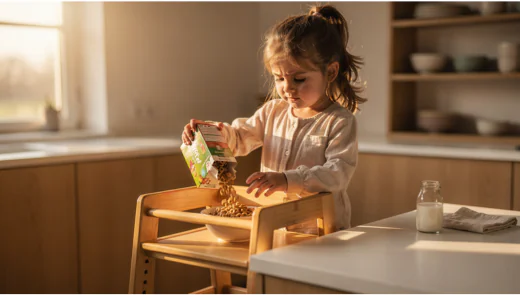
My four-year-old wanted to pour her own cereal. I said yes — then grabbed the box when she tilted it too far. She burst into tears. Not because of the spilled cereal. Because I took over. Again.
A 32-year study in the Proceedings of the National Academy of Sciences followed 1,000 children from birth to adulthood. Childhood self-control — not IQ, not family income, not school performance — predicted adult health, wealth, and wellbeing more powerfully than any other factor. The researchers called it the single most consequential variable in human development — and the Montessori parenting style was built to develop exactly that.
The Montessori parenting style — a child-centered, evidence-based philosophy rooted in Dr. Maria Montessori’s century of direct observation — was specifically designed to build exactly that capacity. Not through pressure or reward charts. Through freedom within limits — a respectful parenting approach that treats your child’s drive toward independence as a neurological gift rather than a behavioral problem.
What separates this guide from everything else you will read is one concept most Montessori articles never explain: sensitive periods. These are time-limited neurological windows during which your child absorbs specific skills through child-led learning and hands-on learning with an ease that will never come this naturally again.
Your child is in one right now.
Miss it, and it is gone. Protect it, and it compounds for a lifetime.
The Five Core Principles of Montessori Parenting style
The parent who stops interrupting their child more than they redirect them will see a different child within two weeks. I know because I was the parent who could not stop interrupting.
My son turned two and a half, and putting on one shoe started taking longer than filing my taxes. What I did not understand then: he was not being difficult. He was being developmental. Every frustrated grab, every “let me do it myself” — all of it was neurologically purposeful. His brain was building executive function one refused piece of help at a time.
These five principles are not abstract philosophy. They are the map I wish someone had handed me at 8:17am.
Observation — Watch Before You React Watch ten seconds before intervening. Ask what the behavior is communicating before asking how to stop it. Parental observation practiced as an active skill — not passive waiting — is the single highest-leverage shift in this entire framework.
Freedom Within Limits — The River Needs Banks Real choices within non-negotiable boundaries. Two outfit options, not unlimited ones. The limit is the riverbank. The freedom is the river. Both are essential. Children given structured choice show stronger self-regulation than children given either total freedom or none — a finding consistent across autonomy-supportive parenting research. Two options is not a restriction. It is a gift your child’s developing brain is not yet equipped to refuse.
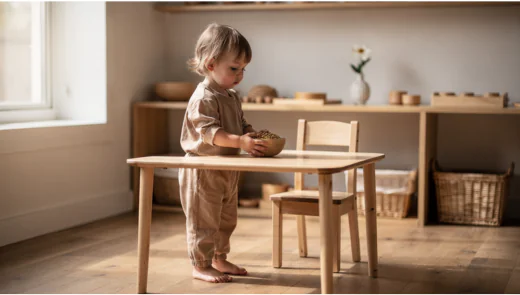
The Prepared Environment — Function Over Aesthetics Practical life activities — cooking, pouring, folding — build more intrinsic motivation than any purchased curriculum. The prepared home environment was never about aesthetics. It was about making independence physically possible before you ask for it emotionally.
Respect — A Behavior, Not a Feeling “You are working so hard on those socks,” before “we have to go.” Effort acknowledged before the timeline. Acknowledging effort before redirecting activates cooperation rather than defensive shutdown — a neurological shift that takes three seconds and costs nothing.
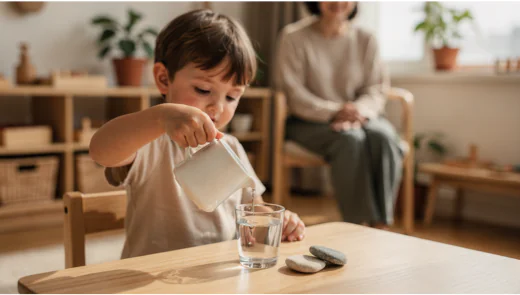
Follow the Child — Trust the Obsession. My daughter ignored letters at three and a half. She arranged rocks by size for weeks instead. She was in an active sensitive period for order within her planes of development. At four and a half, she was reading within eight weeks of showing interest.
Her obsession was not a detour from development. It was development.
The reason these principles work is not philosophical. It is neurological — and your child’s brain is the proof.
Sensitive Periods in Montessori Parenting Style — The Windows Your Child Has Right Now
Your child’s brain will never again learn anything the way it is learning right now.
My son was eighteen months old when he became obsessed with closing doors. Every door. Every cabinet. Every drawer. If I opened one before he could close it himself, the meltdown was immediate and total.
His pediatrician smiled and said, “He is in a sensitive period for order. This is exactly right.”
I stopped fighting his behavior. I started reading it instead.
What Are Sensitive Periods? The Neuroscience Behind Effortless Learning
Sensitive periods are neurologically driven windows during which a child’s brain is specifically primed to absorb certain skills with effortless ease. This process is powered by what Montessori called the absorbent mind — the unconscious learning capacity children carry from birth to age six.
Neuroscientist Patricia Kuhl at the University of Washington confirmed this directly. Between six and twelve months, infants’ brains measurably narrow their sensitivity to non-native speech sounds. That window closes permanently.
A child raised bilingual during this window picks up both languages the way they pick up walking — no lessons, no flashcards, no effort required. Every adult who has struggled through Duolingo for three years and still cannot order coffee abroad knows exactly what closes when this window shuts. Neural plasticity is highest during these windows and consolidates irreversibly as each sensitive period completes.
When the window closes, the skill can still be learned — but it requires conscious effort rather than effortless absorption. The difference between a child learning to walk and an adult learning to tightrope walk. These are the words of encouragement for mothers — the window is open, and you are here.
The Six Montessori Sensitive Periods — What They Look Like in Your Home
Understanding your child’s planes of development means recognizing which window is open right now:
- Language (birth–6 years) — The child narrating everything and demanding the same book nightly is in peak acquisition mode. Every word absorbed now builds the foundation for every communication skill they will carry for life.
- Sensitive period for order (18 months–3.5 years) — The toddler melting down over triangles instead of squares is not defiant. Their brains are building the organizational architecture that later supports logical thinking.
- Sensory Refinement (birth–5 years) — Real cooking, gardening, and water play are developmentally appropriate neurological investments. Screen time during this window displaces the hands-on sensory input the brain is specifically seeking.
- Movement (birth–5 years) — Movement is not a break from learning at this stage. It is the mechanism of learning. Sitting still actively works against development.
- Small Objects (1–4 years) — Fine motor neural plasticity in real time. Provide safe small objects rather than removing them all.
- Social Behavior (2.5–6 years) — Grace and courtesy lessons land permanently during this window. Model the behavior. They are absorbing everything they witness.
If none of these describes your child right now, they are between active windows. The intensity passes. The capacity it built does not.
Why Sensitive Periods Shape Adult Wellbeing — The Research Parents Need
Sensitive periods are not stages you survive. They are invitations you either accept or miss.
A 2025 study in Frontiers in Developmental Psychology by Lillard, Jiang, and Tong found that Montessori education during sensitive periods produces measurably higher adult well-being — not just stronger childhood outcomes, but higher happiness, meaning, and self-confidence measured in adulthood.
My son is six. The door-closing stopped. The internal sense of order it built — his comfort with systems, his ease with routines — stayed.
The Montessori parenting style does not ask you to understand developmental theory. It asks you to trust what you are watching — and to get out of the way. That is harder than it sounds. It turns out most of us were never taught to watch.

The Neuroscience — Why Montessori Parenting Works in Your Child’s Brain
Nobody designed the Montessori parenting style around brain science. Maria Montessori designed it around children, and the brain science arrived sixty years later to confirm she had been right about everything.
What Is Actually Happening Inside Your Child’s Brain
The prefrontal cortex — responsible for executive function development, impulse control, and self-regulation — develops most rapidly between ages three and six. This is precisely the window Montessori parenting style was built around, decades before brain imaging confirmed it.
Every time your child sustains an uninterrupted work period and transitions independently, they are exercising the prefrontal cortex the way an athlete exercises a muscle in the gym. Interrupt the work period and the same thing happens neurologically as skipping the workout.
The Harvard Center on the Developing Child calls this the brain’s “air traffic control system.” Serve-and-return interactions — observation followed by responsive child-led guidance — directly support the development of executive function infrastructure that children carry into every challenge that follows.
Hands-on learning accelerates this further. When a child physically manipulates objects, their brain activates two pathways at once — sensorimotor and cognitive. This dual-channel process creates memory consolidation that verbal instruction alone cannot replicate. This is why a child who pours water remembers. A child who watches someone pour water forgets. Parent with grace — and the child carries that into every challenge that follows.
What PNAS Research Shows About Montessori and Executive Function
Angeline Lillard at the University of Virginia led the first national RCT of public Montessori preschool, published in PNAS (2025) — 588 children, 24 schools, ages three through kindergarten. Montessori children showed significantly stronger reading, memory, executive function, and social understanding.
Moffitt et al., PNAS (2011), followed 1,000 children to age 32. Childhood self-control predicted adult health, wealth, and relationships more powerfully than IQ or social class combined — independently of both.
The child practicing self-regulation at your kitchen table at four is not just learning to wait. They are building the neural architecture that will determine the quality of their adult life.
Why the Sticker Matters Neurologically
Intrinsic motivation and extrinsic motivation do not simply feel different. They activate competing reward pathways — and only one survives removal of the reward.
Edward Deci and Richard Ryan’s Self-Determination Theory established that autonomy, competence, and relatedness generate genuine, lasting motivation. Montessori satisfies all three: the child chooses their activity (autonomy), completes it without rescue (competence), and works alongside others in a prepared community (relatedness).
When you resist the reward chart — and your mother-in-law is standing right there suggesting you just give the sticker — you are not being rigid. You are protecting a neural pathway the sticker would gradually dismantle. The Harvard Center on the Developing Child identifies this intrinsic motivation pathway as the foundation of holistic development — the evidence-based case for trusting a child to want to learn without being paid to do it.

How to Practice Montessori Parenting at Home — A Real Daily Guide
The Montessori home does not look different. It functions differently — and the difference is invisible until you see a three-year-old carry a bowl of cereal to the table with the focused dignity of someone who has never needed help.
She got thirty percent in the bowl. She ate every single piece. Then looked up at me with an expression I had never seen at breakfast before. These are the giveaways — what this mom found at breakfast.
This is mastery — not the performance of competence, but the private experience of it. Children who regularly access mastery through practical life activities develop a self-concept built on capability rather than approval. That distinction follows them for life.
Three Home Changes That Cost Nothing and Build Real Independence
Before buying anything, change three things that cost nothing:
- Lower one hook — they hang their own coat without asking, eliminating one daily negotiation permanently
- Clear one low shelf in the kitchen — accessible snacks, they serve themselves, build genuine parental observation data about what your child can already do independently
- Add a one-step stool at the sink — handwashing becomes their responsibility, not your reminder
When you prepare the environment this way, your kitchen becomes your most powerful prepared home environment. Real food, real tools, real contribution — this is practical life activities in its truest form. Children are not requesting responsibility. They are neurologically ready for it months before most parents recognize the signal.
The Real Montessori Morning
7:00am — The daily routine actually begins the night before, when nobody is tired and nobody is late. Clothes chosen from two options your child picked themselves. It costs forty-five seconds the night before. It buys eleven minutes of independence the next morning.
7:20am — They pour. Something spills. A cloth lives in the same spot every day. They clean it. You understand for the first time why developmentally appropriate challenges matter more than clean floors.
7:45am — Twenty minutes of uninterrupted work period. One activity. You observe the child without redirecting. The most child-centered investment of twenty minutes available to any parent on any schedule.
8:15am — “We leave in five minutes.” Always five. Never zero. Follow the child’s need for transition time and a battle that used to take fifteen minutes disappears entirely. The five-minute warning is not a parenting trick. It is respect made practical.
The NICHD Study confirmed: quality of parent-child interaction predicts outcomes far more powerfully than quantity of time. Forty intentional minutes outperforms a distracted full day.
The child who pours her own cereal at three is the child who packs her own bag at six — without anyone asking. You are not doing less. You are building more.
Montessori Discipline — What It Is, What It Isn’t, and What to Actually Say
The night my son threw his dinner plate on the floor and held eye contact with me while doing it, I understood something I had been reading about for months but had not yet felt in my body: he was not challenging my authority. He was showing me his limit — the only way a three-year-old can.
The plate was the only sentence he knew how to form.
What Montessori Discipline Actually Is
The Montessori parenting style treats every behavioral incident as information first. Not “how do I stop this” but “what is this telling me.“
That single reframe changes everything — not just how you respond, but how dysregulated behavior feels. It shifts from personal attack to developmental communication, you are learning to translate.
This aligns with Diana Baumrind’s authoritative parenting — high warmth combined with high structure. A 2023 systematic review of 32 studies in Campbell Systematic Reviews confirmed this approach produces significantly stronger self-regulation and emotional regulation than conventional discipline. The same review found that children in authoritative environments showed stronger social competence at five, eight, and twelve years — the effect does not fade.
Self-regulation is the goal. Not compliance. A child who builds the internal capacity to choose differently — eventually, nonlinearly, slowly.
My son took fourteen months. Not two weeks. Not one impressive dinner party. Fourteen months — including three weeks in month nine, where I was genuinely convinced I had broken something. Every article made it sound faster. It is slow and involves regression at the worst possible moments.
It works anyway.
Three mechanisms — and only one of them requires anything from you in the moment:
Natural consequences work because they are not invented by you. The paint dries on the brush your child left uncapped. The tower falls when it is built too fast. No lecture required — the environment teaches what you cannot. This is not permissiveness. It is precision.
Model grace and courtesy— but understand what modeling actually means neurologically. Your child is not watching what you say when they misbehave. They are watching what your face does. What your voice does. Whether you stay or leave. The parent who breathes through their own frustration is doing more developmental work than any time-out ever achieved.
Observe before responding— ten seconds before anything. I set a phone timer for three months because at 6pm my principles evaporated without a mechanical reminder. The timer is not a trick. It is the gap between reaction and response. That gap is where Montessori discipline actually lives.

What Montessori Discipline Is Not — The Line Parents Keep Crossing
Freedom within limits means the limit does not move. Not when your child cries. Not when they escalate. Not when it is 6 pm, and the path of least resistance is right there.
The night of the plate: dinner finished, floor cleaned together, sat quietly until both of us were regulated. No timeout. No negotiation. No abandonment.
That sitting together — regulated adult, dysregulated child — is what positive discipline looks like in a real kitchen on a real evening. Jane Nelsen identified the mechanism precisely: children do not behave better when they feel worse. They behave better when they feel genuinely connected and capable of doing differently.
What to Actually Say
| Situation | Reactive | Montessori |
| Refuses shoes | “Dinner is over.” | “Three minutes. Sneakers or boots?” |
| Hits sibling | “Say sorry.” | “Food stays on the table. Let’s clean together.” |
| Won’t clean up | “No screen time” | “The shelf needs the blocks back. Need a hand?” |
| Throws food | “Stop crying.” | “You’re frustrated. Breathe with me first.” |
| Full meltdown | “Hitting hurts. Let’s find another way.” | “You’re frustrated. Breathe with me first” |
Last week, my son spilled his juice, looked at me, and said, “I’ll get the cloth.”
He did not ask. He did not wait. He just went and got it.
Fourteen months of imperfect practice. One Montessori guide said, “You are not failing. You are in the middle.”
Keep going.
The Part Nobody Talks About — Montessori Parenting Style’s Hardest Skill
The hardest part of the Montessori parenting style has nothing to do with your child. It has everything to do with what happens in your body when you watch them struggle and do not intervene.
My four-year-old was folding a towel. Eleven minutes in, it looked like it had survived something. My hands were twitching. My jaw was tight. I was doing the silent calculation every parent knows — subtracting what I was watching from what I had imagined it would look like, arriving at a number that made my hands twitch.
My daughter was completely calm. I was the one who was not.
Dr. Maria Montessori called this adult self-preparation — the inner work required before any external technique becomes genuinely available to you. She was not being philosophical. She was being precise.
A parent who cannot regulate their own nervous system cannot accurately observe the child. They cannot scaffold independence without anxiety leaking through every interaction. They cannot hold the unhurried space that child-led learning requires.
Dan Siegel confirmed this neurologically: co-regulation — a parent’s regulated nervous system actively settling their child’s developing one — is not a metaphor. It is a measurable biological process. In the Montessori parenting style, your internal state is the parenting environment. A 2019 study in Mindfulness confirmed that parents practicing mindful self-regulation reported substantially less reactive parenting and significantly higher parental sensitivity — the precise capacity this approach demands most.
Three Prerequisites — Not Suggestions
Pause two seconds before every intervention. Ask one question: Does my child need this, or do I need to give it? Different needs. Different answers.
Name your triggers before they name you. A trigger you identified calmly is one you can prepare for rather than react to.
Separate process from outcome. The towel does not need to look like a towel. It needs to have been folded by your child.
My daughter folded that towel imperfectly for two weeks. Then one morning it looked like a towel. A month later, she was folding her own laundry and teaching her younger brother how.
Everything was developing. I just could not see it yet.
You cannot consistently give your child what you have not yet developed in yourself. Self-regulation in the Montessori parenting style is not one technique among many. It is the ground everything else grows from, and the towel moment is where you find out whether you have built it.

Montessori vs. Gentle Parenting — The Comparison Parents Actually Need
Two parents using different frameworks can raise equally thriving children — and still be missing half the picture.
My sister does gentle parenting. I do Montessori. We have had the same argument eleven times. Both of our children are doing genuinely well.
Both belong to the same family of respectful parenting — built on empathy, intrinsic motivation over external rewards, and Diana Baumrind’s authoritative parenting framework. A 2023 systematic review of 32 studies in Campbell Systematic Reviews confirmed this combination produces significantly stronger self-regulation and social cognition across every demographic studied. The research does not distinguish between gentle parenting and Montessori. Both produce the outcome. The paths differ.
Montessori parenting style differs from gentle parenting in one fundamental way.
Gentle parenting asks: how do I respond to my child emotionally right now?
Montessori parenting style asks: what environment do I create, which sensitive periods do I recognize, and how do I scaffold independence before dysregulation begins?
Last November my nephew had his third transition meltdown at the same dinner moment. My sister handled each one with extraordinary patience — and looked exhausted by the third. I watched and thought: he does not have a regulation problem. He has a transition problem. A transition problem is a prepared home environment problem — and it is solvable before dinner, not during it.
I told her about five-minute warnings and the sensitive period for orders.
She said: “Why has nobody told me this before?”
Gentle parenting is your relational language. The Montessori parenting style is your developmental framework. Use one, and you are equipped. Use both, and you are fluent in the full conversation your child is trying to have with you.
Montessori parenting FAQS
Can I practice Montessori parenting if my child attends a traditional school?
Yes — completely. The Montessori parenting style lives at home independently of school. Your prepared home environment, parental observation practice, and freedom within limits apply every evening. What happens in your home between 4pm and bedtime shapes development more than most parents realize.
At what age should I start?
Birth. The absorbent mind operates from birth to age six — making the first plane of development the highest concentration of sensitive period activity in a child’s entire lifetime. Earlier genuinely matters. But parents who start at three, five, or eight still report meaningful shifts in cooperation, independence, and connection within weeks.
Do I need expensive materials?
No. Maria Montessori’s original children had no purchased materials. Practical life activities — cooking, pouring, folding, cleaning — are the original Montessori curriculum. The most Montessori object in your home is a step stool at the kitchen sink.
Is Montessori parenting suitable for strong-willed or neurodivergent children?
Often exceptionally well-suited. Montessori’s movement integration, sensory engagement, and child-led learning naturally accommodate children with ADHD and sensory processing differences — because the framework was built around following the child’s neurological lead, not overriding it. Freedom within limits reduces power struggles by eliminating the conditions that produce them.
What if my partner does not support the Montessori parenting style?
Start with shared values, not terminology. My husband’s turning point was not a philosophy — it was a midnight screenshot of a PNAS study. Most partners respond to outcomes before they respond to labels. One principle. One data point. One Tuesday morning at a time.
How long before I see results?
Calmer routines and fewer power struggles appear within weeks. The deeper outcomes — executive function, self-regulation, emotional regulation — compound over years. A 2025 PNAS study found the effects strengthened as children aged. You will not see everything that is developing. That does not mean nothing is developing.
The Investment You Are Making Every Day
Here is what thirty-two years of following 1,000 children from birth to adulthood found: childhood self-regulation — not IQ, not family income, not school performance — predicted adult health, wealth, and wellbeing more powerfully than any other variable the researchers measured.
Not curriculum. Not test scores.
The quiet, daily, unglamorous practice of building self-regulation in a child who is still learning how.
That is what the Montessori parenting style is actually doing every morning you wait while the cereal spills. Every limit you hold without negotiating. Every sensitive period you protect that nobody else in the room recognizes as the neurological investment it is.
The evidence is unambiguous. Angeline Lillard’s 2025 PNAS national RCT confirmed it across 588 children in 24 public schools. Moffitt et al.’s 32-year longitudinal study confirmed it across a lifetime. The Harvard Center on the Developing Child confirmed it across decades of brain research. A child-centered environment built around hands-on learning, child-led learning, and genuine intrinsic motivation produces measurable results. Executive function, emotional regulation, social cognition, and emotional intelligence — these are the holistic development outcomes that predict flourishing across an entire life.
This is not a philosophy you have to believe in.
It is a body of evidence you can trust.
Tomorrow morning — one thing. Not three. One.
Find the sensitive period your child is in right now — the obsession, the phase, the behavior you have been managing instead of reading. Name it. Protect it for one week without intervening.
That is it. That is the whole practice.
The hook, the shelf, the step stool can wait. The work period can wait. The five-minute warning can wait. The window your child is in right now cannot.
The child who pours their own cereal at three is the child who navigates their own life at twenty-five. With the quiet confidence of someone trusted with real things since the beginning.
That confidence was not given to them.
It was built — by you, in your kitchen, on a Tuesday, with a cereal box and four paper towels and the hardest Montessori parenting style skill there is.
Doing nothing.
And meaning everything.