You remember the feeling. Standing at the classroom door, watching your kid’s fingers tighten around yours — that pause before they let go. You smile and say,, “You’ll be great,” but you’re anxious. You’re not imagining it: 53% of parents call back-to-school season the most stressful time of year.
What surprised me most, digging into this: APA research (2023) found kids who become likeable among classmates fare better all year. It’s not from being outgoing — it’s from having a reason to talk. My neighbor’s son went from silent to inseparable with a classmate after a round of Two Truths and a Lie.
That’s the real job of icebreaker games for kids — get-to-know-you games that build lasting belonging. This one explains why.
Why Icebreaker Games for Kids Actually Work
These games aren’t filler before “real” learning starts — they’re rewiring something. Harvard’s Center on the Developing Child calls it ‘serve and return.’ It’s the back-and-forth of a child reaching out and someone answering — and its own research says this shapes brain architecture from infancy on. (developingchild.harvard.edu). But watch two seven-year-olds toss a beanbag and trade answers — same wiring, one turn at a time.
That serve-and-return instinct is also why belonging matters so much. It’s tied to how well kids engage, persist, and even perform academically — confirmed by a 2024 systematic review. (pmc.ncbi.nlm.nih.gov/articles/PMC11592540/). CASEL names belonging-building as part of social-emotional learning (SEL) — one of five core competencies kids need.
The Fast Friends Effect
A parent at pickup once told me her son came home saying he’d “found his person” after one round of Two Truths and a Lie. Psychologist Arthur Aron, of Stony Brook University, found in 1997 that gradually deepening sharing between strangers builds closeness faster than small talk. It’s the same principle — just among peers.
The Academic Connection
Durlak et al. ran a 2011 meta-analysis of 213 SEL programs and 270,000+ students. They found an 11-percentile-point achievement gain versus controls. Icebreaker games for kids tap that same engine:
- Create psychological safety before academic risk-taking is expected
- Form peer relationships that ease first-week anxiety
- Give quiet kids a low-stakes way in — a “pass” card, not a spotlight
That back-and-forth is the whole point. Give one today — and watch what comes back.
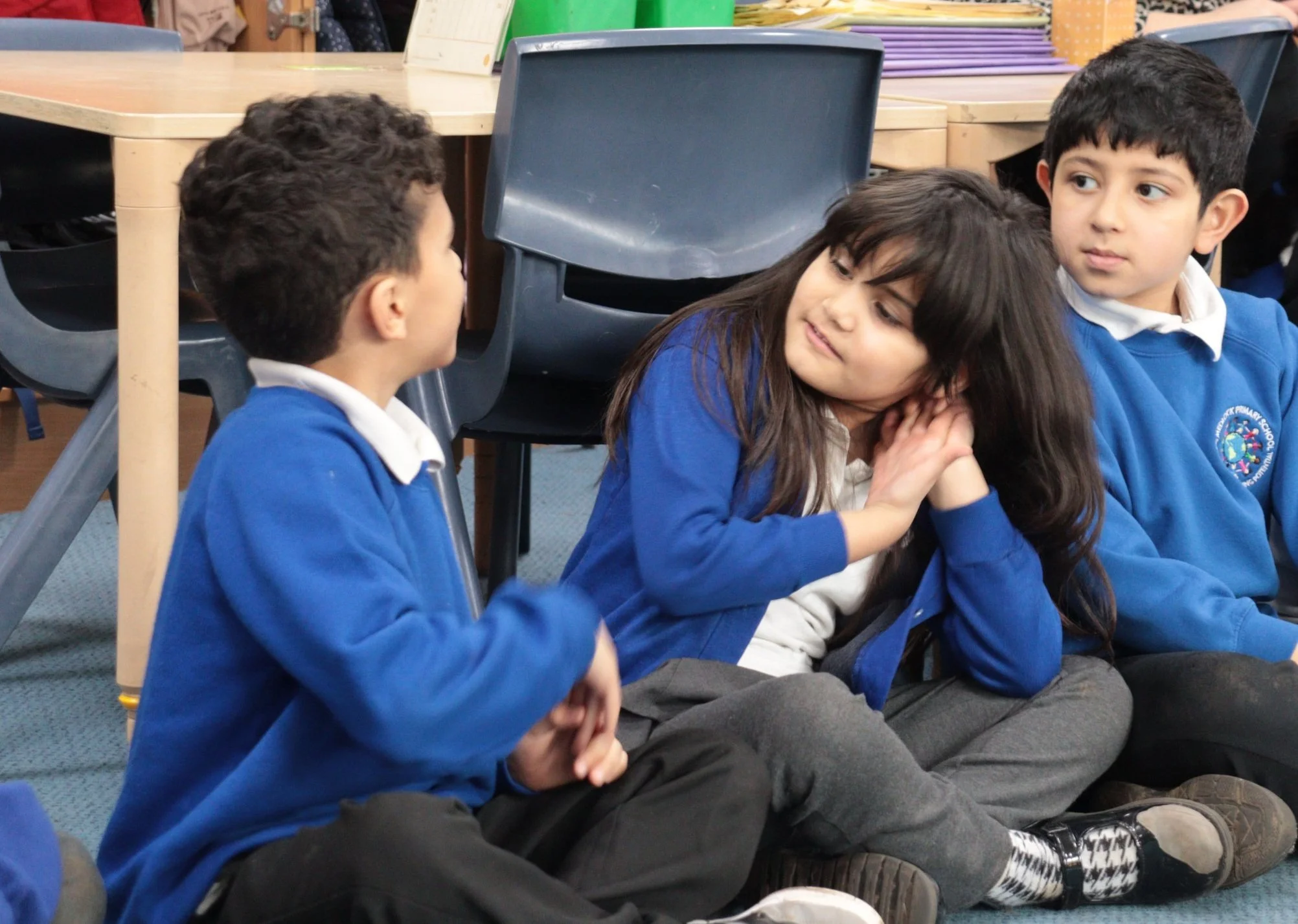
How to Choose the Right Icebreaker for Your Class
Picking the wrong icebreaker doesn’t just fall flat — it can make a shy kid dread class for weeks. Most guides hand you 20 games and let you guess. Here’s the filter they skip.
UNICEF’s 2018 ‘Learning through Play’ report makes a point most teachers miss: play isn’t one thing. Different formats build different skills — cognitive, social, emotional, physical. So match the game’s format to what your room actually needs that day. Don’t just match it to what day of the week it is.
Ask three quick questions — ten seconds, saves you a flop:
- Group size: Large class? Pairs or small groups, not one long line.
- Energy level: Restless after recess? Movement-based — A Great Wind Blows burns off wiggles fast. Just left a quiet lesson? Keep it seated.
- Comfort level: Brand-new kids, day one? Start low-pressure, no personal disclosure. ZERO TO THREE recommends easing cautious kids in with side-by-side play first.
My daughter’s teacher learned this the hard way. She opened day one with ‘tell your most embarrassing moment,’ and half the room stared at their shoes. The next week: a quiet paired activity instead. My daughter came home talking about someone new.
Age matters too — third graders shout favorite colors happily; sixth graders won’t. If your class skews older, it’s worth browsing games for middle schoolers instead of forcing a younger-grade favorite. Most of these adapt to virtual classrooms too — “stand up” becomes “turn on your camera.”
Match the room, not the calendar. That’s the whole filter.
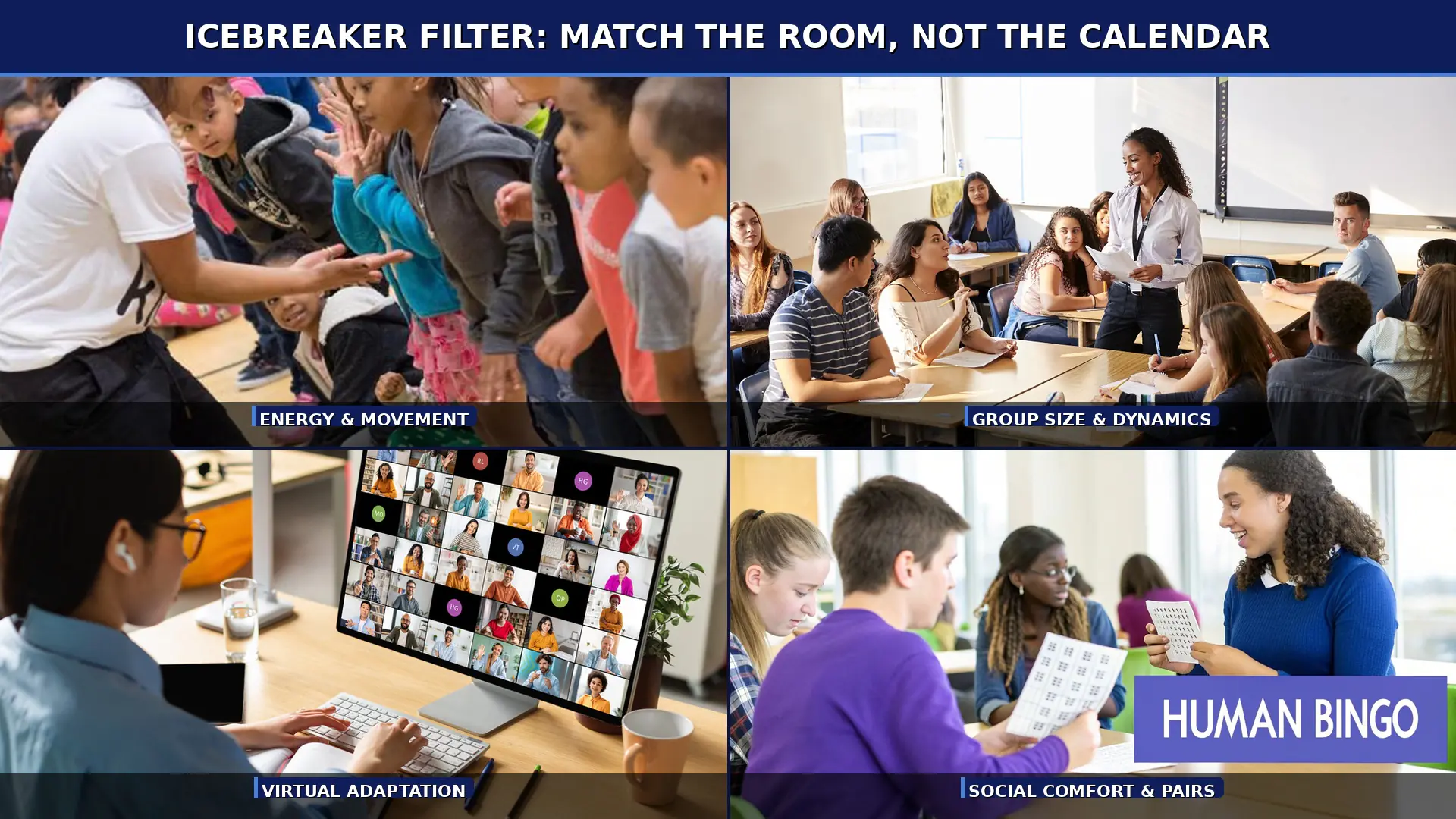
10 Best Icebreaker Games for Kids
Forget the 30-item scroll. Here are the 10 icebreaker games actually worth running — almost all need zero supplies beyond what’s already in the room.
Low-Energy, Seated Games
- Two Truths and a Lie: Kids share three “facts,” and classmates guess the lie — reciprocal sharing, the exact mechanism behind real closeness.
- Would You Rather: There’s no wrong answer here, which is exactly why it’s the safest first game to run with a class you don’t know yet.
- Table Talk Questions: A rotating weekly question keeps the connection going past day one.
- Bean Bag Toss Q&A: Toss, answer, pass — builds confidence one turn at a time.
- The Story of My Name: Small disclosure, real belonging.
High-Energy, Movement Games
- This or That: Split the room by preference; reveals shared interests instantly.
- Line Up By Birthday (No Talking): Forces non-verbal teamwork.
- Human Bingo: Kids interview each other to fill a card.
- A Great Wind Blows: The only game on this list where everyone moves at once — nobody’s watched, because everyone’s watching the room, not each other.
- Toss It to Me: Stand in a circle, toss the ball, say names.
Nobody tells you this part: the best game isn’t a new one — it’s the one you already ran last week. Melanie Dirks, PhD, of McGill University, said something worth remembering in APA’s 2023 ‘Science of Friendship’ report. Friendships, she said, are the first relationships in life we get to freely choose. Repetition is what turns a game into a real choice, not a stunt.
My son’s third-grade teacher runs Two Truths and a Lie every Monday, not just week one. Now he actually talks about school again.
Run one twice before you try something new — that’s the real secret.
Making Icebreakers Inclusive for Every Kid
Pretending every kid experiences these games the same way leaves shy students behind — and the numbers back that up. NIMH-affiliated research on teens found 47% self-identify as shy.
But only 12% of that group met criteria for social phobia — a distinct, more severe condition. Most ‘shy’ kids just need a gentler pace, not a diagnosis. But ongoing shyness that disrupts daily life is worth a conversation with your child’s teacher — not a classroom fix.
The part every list leaves out: inclusion isn’t about the shy kid changing — it’s about who’s doing the noticing. Harvard’s Making Caring Common project calls this the ‘Circle of Concern.
‘ It means actively widening who you pay attention to, since kids naturally empathize most with those already inside their circle. (mcc.gse.harvard.edu/resources-for-educators). A “pass” card does this literally — it puts the quiet kid inside the circle without a spotlight.
The “Is This Too Personal?” Test
Does the question reveal something about home life, money, or family a child can’t control? Skip it if so.
Adapting for Real Classrooms
- Offer a silent “pass” card
- Let anxious kids answer in pairs first
- Give a sentence starter for kids who freeze
My daughter used to cry before the first day, every year.Her teacher kept a ‘pass’ jar on the desk. She used it twice in September, then raised her hand by October — no one forcing it. That’s what widening the circle looks like.
Beyond Day One: Debrief and Keep the Connection Going
The game isn’t what builds connection — the 60 seconds after it does. Close every round with one question: “Name one thing you just learned about someone.” UCLA psychologist Matthew Lieberman’s research found something surprising: simply putting an experience into words calms the brain’s stress response more than staying quiet about it. Turns out the debrief isn’t a nice-to-have — it’s doing real neurological work, not just wrapping up a game.
They work best as a rhythm, not a one-time event:
Week 1: name and fact-sharing games
Week 2: shared-interest games
Week 3: light team-building
My son’s teacher runs a two-minute debrief every Friday. By October, he asked at dinner, “Guess what I learned about someone today?” Now it’s our ritual too.
Revisiting the game matters as much as choosing it. That’s how closeness actually holds.
FAQ
What is the purpose of an icebreaker game?
Icebreaker games for kids build early connection and belonging between classmates, easing first-day anxiety while giving quieter kids a low-pressure way in.
How do I choose the right icebreaker for my class?
Match it to group size, energy, and comfort level — and when unsure, always guess gentler. You can always ramp up next time; you can’t easily undo a kid’s bad first impression of the whole idea.
What are good icebreaker games for shy kids?
Paired activities like Would You Rather or a silent “pass” card work best — Understood.org found 94% of parents of neurodivergent kids feel back-to-school stress, so gentler options matter more than you’d think.
How long should an icebreaker last?
5–10 minutes total, debrief included. Much longer and you’ve made it a lesson, not an icebreaker.”
How often should you use icebreakers?
Weekly beats one big day-one event, based on Aron’s 1997 closeness research and ZERO TO THREE’s pacing guidance. Most parents skip it on the busiest Mondays — exactly when class needs it most.
Bringing It All Together
That kid at the classroom door doesn’t need 30 games — he needs one, chosen well, followed by sixty real seconds after. Here’s what nobody tells you: the game teaches the skill, but the debrief is what makes it stick — the same start-shallow, build-deeper pattern that makes any relationship, adult or seven-year-old, actually last. I’ve watched a silent kid become the one asking “can we play that again?” by week three.
Pick one game. Run it Monday. Debrief for sixty seconds. That’s not a tip — that’s the whole method.