

Here’s what separates qualified trauma therapists from those who dabble: their ability to answer specific questions about structure and outcomes in therapy for children with trauma. The Session Structure Question That Reveals Everything
Ask this: “How is each session divided between time with my child and time with me?”
The correct answer for Trauma-Focused Cognitive Behavioral Therapy is specific: approximately 30 minutes individually with the child and 30 minutes individually with the parent during most sessions.
If a therapist can’t give you this level of detail, they may not be adequately trained. This parallel structure isn’t optional; it’s how the therapy works. Parents receive the same skills training as children, enabling them to support practice at home during the six days between sessions.
Unlike Therapy for Children’s Anxiety that focuses on worry patterns, or Early Intervention Therapy for Children addressing developmental delays, trauma therapy specifically targets traumatic event processing and requires this unique parent-child parallel structure.
The Trust-Building Question
“What happens during the first two months if my child won’t talk about the trauma?”
The research shows that children who’ve endured trauma, abuse, or neglect. May need 6-8 weeks just to feel safe enough to start opening up. If a therapist expects rapid disclosure, that’s a red flag. The trust-building phase IS therapy for children with trauma, not a delay before “real” therapy begins.

What to Expect in Your Child’s First Trauma Therapy Session (A Week-by-Week Timeline)
Most resources describe vague “phases.” Here’s the actual week-by-week breakdown for therapy for children with trauma.
Weeks 1-4: Stabilization (Why It Looks Like “Just Playing”)
The first phase focuses on psychoeducation and stabilization. Therapists work with families to understand the connection between trauma exposure and current symptoms.
Children learn relaxation skills for trauma triggers (deep breathing, progressive muscle relaxation), feeling words to express internal experiences, and how thoughts, feelings, and behaviors connect.
Meanwhile, you’re meeting separately with the therapist, learning the same skills. This parallel structure means you can coach your child at home when they encounter triggers during the week.
Weeks 5-12: Trauma Narrative and Processing
Children begin describing the traumatic event in increasing detail. Some create narratives in book form, with chapters. Others use comic strips, drawings, poems, or puppet shows.
As children recount their narratives, therapists identify cognitive distortions: “It was my fault,” “I should have stopped it.” The therapist helps children develop more accurate thoughts about their trauma exposure.
Weeks 13-18: Conjoint Sessions and Integration
The therapist provides several conjoint child-parent sessions. Before the first conjoint session, the therapist meets briefly with parents alone (5-10 minutes) and the child alone (5-10 minutes), then brings them together for 40-50 minutes.
The first conjoint session is typically devoted to the child sharing their trauma narrative with parents present. But here’s the key: parents have already heard and cognitively processed this narrative during their individual sessions. This prevents parents from having overwhelming reactions that could shut down the child’s disclosure.
When Your Child Refuses to Talk: Creative Therapy Approaches That Work Without Words
After trauma, many children keep things to themselves. They may lack words for their experiences, especially younger children whose developmental stage limits verbal expression.
Why Nonverbal Approaches Work
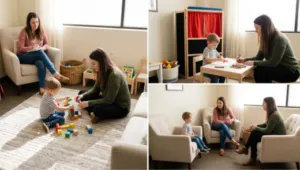
Young children often find it difficult to articulate feelings. For them, tools like art, music, and play become essential methods for therapy for children with trauma.
Play Therapy allows children ages 3-8 to work through trauma by enacting scenarios, using toys to represent people and events, and processing experiences through symbolic play rather than verbal explanation.
Art Therapy provides children who struggle to verbalize experiences a way to express emotions through drawing, painting, and sculpting. The creative act itself facilitates healing without requiring words for overwhelming experiences.
Narrative Therapy uses storytelling to help children externalize trauma. They create stories about characters experiencing similar events, gaining perspective by viewing situations from outside their own perspective.
These aren’t inferior alternatives—they’re often the primary and most effective method for processing trauma in developing brains.

Trauma Therapy for Children in Crisis: CPS Involvement, Foster Care, and Homelessness
Children in foster care face a unique trauma profile. Here’s what the research shows about therapy for children with trauma in these situations.
The Trauma Load in Foster Care
Research documents that the mean number of traumas experienced by children in placement is 4.7 traumatic events. For foster children with complex trauma, that means it rises to 5.8 traumas. These children haven’t experienced one terrible thing; they’ve experienced an average of nearly six traumatic events.
Another study found that 93% of children in treatment foster care experienced one or more traumas, with almost half experiencing four or more types of trauma. This is compounded trauma requiring extended, specialized treatment.
Why Removal Itself Is Traumatic
Even setting aside experiences that brought children into foster care, removal from familiar environments, multiple placement moves, and loss of connections create additional trauma. The rescue was necessary, but it was still traumatic.
Children who experienced abuse or neglect from primary caregivers often have profound difficulty developing healthy attachments to foster or adoptive parents. Standard therapy timelines don’t apply—trust-building alone can extend treatment by months beyond typical timelines.

The Real Timeline: How Long Does Child Trauma Therapy Actually Take
TF-CBT typically involves 12-16 weekly sessions. But several factors significantly alter this timeline for therapy for children with trauma.
Trauma Type and Complexity
Single-incident trauma typically requires shorter treatment. Repeated trauma over months or years creates fragmented memories and pervasive feelings of unsafety. Processing this takes substantially longer—up to 25 sessions.
Support System Strength
Children with strong family support parents who participate fully in treatment, practice skills at home, and provide consistent emotional availability progress measurably faster. The home environment between weekly sessions matters as much as the therapy itself.
The Two-Year Follow-Up Data
Research tracking children for two years post-treatment provides evidence of lasting change. Children who completed TF-CBT maintained their treatment gains at the two-year mark, showing sustained reductions in PTSD symptoms, depression, anxiety, and behavior problems.
Equally significant: parents who participated in treatment showed maintained reductions in their own depression, PTSD symptoms, and distress related to their child’s trauma. Parental improvement and child improvement are correlated, particularly with younger children.

Supporting Your Child at Home: Daily Activities That Reinforce Trauma Therapy
In TF-CBT, parents play a substantial role in their child’s healing. They’re coached to listen in ways that help children open up. They help children practice coping skills at home. They share in positive feelings as their child makes progress.
The Research-Backed Approach
Parents receive advice on how to help their child at home, learning the same skills their child learns. This parallel education enables parents to support skill practice during the six days between therapy for children with trauma sessions.
Research shows parents often report that TF-CBT skills are personally helpful to them. Many families practice skills together at home, developing family resilience rituals that continue long after therapy ends.
Daily Connection Practices
Spend time with your child doing soothing, relaxing, or enjoyable activities. Cook together, walk, play, read, make art, or sing. Try to do this daily, even for a brief time.
Use kind words. Praise your child when they’re doing well or trying hard. When they make mistakes, show patience and demonstrate how to try again. This is trauma-informed parenting that rebuilds safety.
Take a few minutes at bedtime to read a story, snuggle together, or sing to young children. For older children, establish a routine of a goodnight hug plus a few minutes to talk, listen, or laugh together.
Use hugs, smiles, words, and caring actions to show love. After trauma, children need tangible reassurance of safety and connection.
These practices may seem simple—things you already do. But after trauma, this closeness matters profoundly. Giving extra support and time keeps your child feeling loved and connected to you, which is essential for therapy for children with trauma to succeed.