
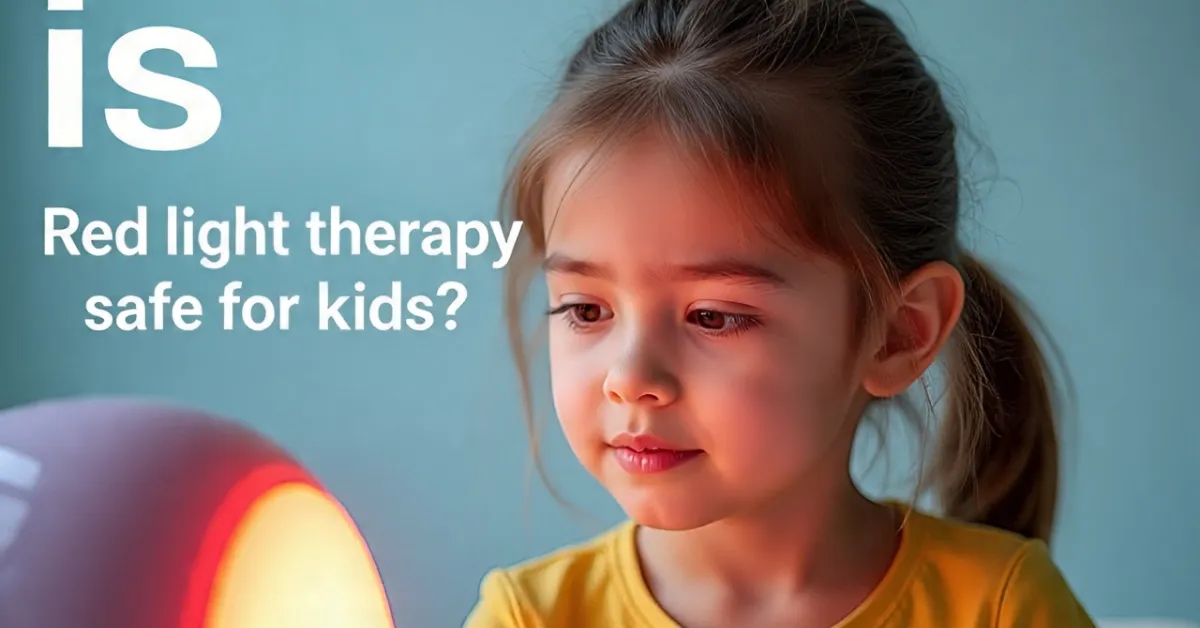
When considering red light therapy for your child, one critical fact determines everything: is red light therapy safe for kids depends entirely on where the light goes. The same technology exists in two different worlds one where children heal safely, another where permanent vision damage becomes a real risk.
Is Red Light Therapy Safe for Kids? What Parents Need to Know in 2024-2025
The Dangerous Assumption Hurting Children
Most parents assume all red light therapy works identically. This misconception has led thousands to purchase devices that experts now consider potentially harmful. The critical difference: external skin applications versus direct eye exposure create completely different risk profiles.
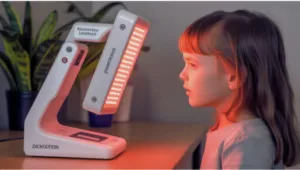
When University of Houston researchers measured commercial myopia devices in January 2024, they discovered something alarming. These instruments deliver light exposure reaching or exceeding maximum safety thresholds. Just three minutes of viewing creates photochemical and thermal risks to retinal tissue.
The protocol calls for children to stare into these devices twice daily, five days weekly, potentially for years, not occasional exposure but cumulative bombardment of developing eyes with energy that safety standards weren’t designed to evaluate.
China’s Regulatory Red Flag
Here’s what should make parents pause: China, where this technology originated, and millions of children received treatment, suddenly reclassified these devices in 2023 as Class III, the highest risk category requiring the strictest oversight, mandatory clinical evaluation, and enhanced quality controls.
The nation with the most real-world experience determined that maximum regulatory protection was necessary. Yet in America, unregulated versions can be purchased online without safety verification, quality control, or adverse event monitoring.
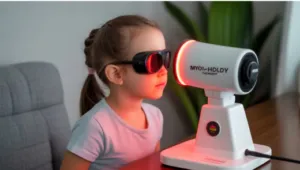
The Critical Difference: Red Light Therapy for Wound Healing vs. Myopia Control in Children
External Applications: The Lower-Risk Path
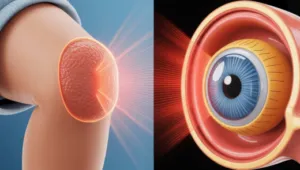
When red light targets a scraped knee or an inflamed muscle, photons penetrate 5-10mm into tissue. The skin absorbs most energy. Treatment lasts minutes. Natural protective reflexes remain intact, and children instinctively move away if uncomfortable.
Direct Retinal Exposure: Where Safety Collapses
Myopia protocols invert every safety principle. Children override natural aversion to bright light, staring directly into devices positioned inches from their faces. Three minutes twice daily, five days weekly, for three years equals 4,680 minutes, 78 hours of direct retinal exposure.
The eye’s optical system concentrates incoming light directly onto the retina, multiplying energy density by orders of magnitude. Photochemical injury accumulates slowly from repeated sub-threshold exposures that eventually overwhelm cellular repair mechanisms.
April 2025 research provided the first direct evidence: reduced cone density in the foveal region, increased photoreceptor outer segment thickness, and abnormal retinal signals in treated children. Whether these represent temporary adaptation or permanent damage remains unknown, but measurable changes should concern every parent.
FDA Status Alert: Why Red Light Therapy for Children’s Eyes Isn’t Approved in the United States
The Approval That Never Came
Over two years since Chinese studies showed myopia reduction, yet the FDA hasn’t approved a single device for pediatric ocular use. This isn’t bureaucratic delay it reflects unresolved fundamental safety questions.
Current evidence doesn’t meet FDA standards. We have short-term efficacy data but lack comprehensive long-term safety monitoring. We see myopia reduction but also documented cellular changes whose clinical significance remains debated.
The Online Device Underground
These devices can be purchased online without a prescription, professional evaluation, or safety verification. They lack calibrated output measurements, quality control testing, built-in safety limiters, post-market monitoring, and professional oversight.
Parents ordering these devices essentially enroll children in uncontrolled experiments without safety monitoring or any mechanism to detect problems before permanent damage occurs.
The 2024-2025 Safety Warnings Every Parent Must Know Before Trying Red Light Therapy
Warning #1: Maximum Exposure Limits Exceeded
University of Houston researchers actually measured commercial devices using calibrated laboratory equipment. Both tested devices approached or exceeded maximum permissible exposure levels when used according to three-minute treatment protocols.
Safety guidelines recommend avoiding similar light intensity for 48 hours after reaching maximum exposure. Yet protocols call for repeated exposure twice within 24 hours, continuing for years.
Warning #2: Cone Photoreceptor Density Reductions
April 2025 imaging revealed reduced cone density in treated children, with the most significant reduction within 0.5mm of the foveal center, where we have the highest concentration of cones, enabling the sharpest vision and color perception.
Treated children showed an average reduction of 2,100 cells per square millimeter compared to controls. These aren’t theoretical risks, they’re actual structural changes visible on advanced imaging, meaning reduced capacity for fine visual detail, potentially for life.
Warning #3: Real-World Use Differs from Research
Published studies assume perfect protocol adherence. Reality differs: children self-administer unsupervised sessions, extend beyond three minutes, viewing distance varies, some double up missed sessions, and device output degrades without calibration.
Every deviation potentially amplifies risks beyond what published studies evaluated.
4 FDA-Approved Alternatives to Red Light Therapy That ARE Safe for Your Child’s Vision
Alternative 1: Essilor Stellest Spectacle Lenses (September 2024)
First spectacle lens receiving FDA authorization for myopia control. Clinical data showed a 71% reduction in myopia progression and a 53% reduction in axial elongation. Zero serious adverse events reported.
No direct retinal exposure, zero risk of infection, instant removal if problems occur. Corrects vision while controlling progression, two benefits from one intervention.
Alternative 2: MiSight 1 Day Contact Lenses (FDA-Approved 2019)
First and only contact lenses specifically approved for slowing myopia progression in children aged 8-12. Demonstrated 59% average reduction over three years with five years of real-world safety data in American children.
Alternative 3: Low-Dose Atropine Eye Drops
Reduces myopic progression by 30-60% depending on concentration. FDA is reviewing a standardized formulation, with an expected decision on October 23, 2025. Currently available off-label through compounding pharmacies.
Alternative 4: Lifestyle Modifications
Research shows 40-80 minutes of daily outdoor time provides measurable benefits. Costs nothing, carries zero medical risks, and provides numerous additional health benefits.
When Red Light Therapy IS Safe for Children: Evidence-Based Guidelines for Wound Healing, Skin Conditions, and Pain Relief
For non-ocular applications, is red light therapy safe for kids? receives a qualified affirmative, with critical requirements.
Safe Applications Include:
- Wound healing: Accelerates healing of cuts, scrapes, burns through increased collagen synthesis
- Sports injuries: Reduces muscle inflammation and joint pain without medication
- Eczema management: Anti-inflammatory benefits without skin-thinning effects of steroids
- Post-surgical scars: Improves appearance when started 2-3 weeks after wound closure
- Pediatric occupational therapy integration: Some therapists incorporate controlled red light sessions for sensory processing support and tissue healing as complementary treatment
- Mood-related disorders: Emerging research suggests that carefully administered red light may support circadian rhythm regulation in children with sleep disturbances, though this application requires professional supervision
Mandatory Safety Requirements:
Children require modified parameters: 5-10 minute sessions (versus 15-20 for adults), 3-4 times weekly (versus daily), 20-30% lower intensity, devices positioned 12-18 inches away (versus 6-12 inches).
Parents must verify that FDA-cleared devices use a 660nm wavelength, have a power output not exceeding 50 mW/cm², maintain a surface temperature below 95°F, and provide age-appropriate protective eyewear.
Who Must Avoid Treatment:
Children with photosensitivity disorders, those taking photosensitizing medications, active skin malignancies, implanted photosensitive devices, or those with an inability to cooperate with eye protection requirements.
The Bottom Line
The question “is red light therapy safe for kids?” has no single answer; context determines everything.
For Myopia Control (Direct Eye Exposure): NO. Devices exceed safety limits, cause measurable reductions in cone density, lack FDA approval, and have unknown long-term effects on developing eyes. Parents have four FDA-authorized alternatives providing comparable control without retinal risks.
For External Therapeutic Use: QUALIFIED YES. When used with FDA-approved devices at pediatric-appropriate parameters under professional supervision and with proper eye protection, red light therapy is considered acceptable for wound healing, skin conditions, and pain management.
Never use unregulated online devices for eye treatment. Your child’s vision deserves proven, FDA-authorized interventions, not experimental protocols with documented risks.