

ATNR Reflex Integration Exercises. The ATNR (Asymmetrical Tonic Neck Reflex) plays a vital role in early motor skill development, yet when this reflex isn’t properly integrated by the typical integration period, it creates a big impact on how children navigate learning, balance skills, and even crossing midline activities.
Research highlights that retained reflexes in individuals on the Autism spectrum or those with ADHD characteristics often struggle with social interaction, poor handwriting, problems in math and reading, and poor eye-hand coordination skills, which reflex exercises can actively address.
What many don’t realize is that ATNR reflex integration serves as a key factor in unlocking attention, motor imitation, and peer interaction, making primitive reflex integration exercises not just helpful for addressing motor delays but essential for building confidence and self-esteem as kids grow and their brains and bodies build important connections that shape how they see and interact with the world.
What You Need to Know About Primitive Reflexes
Primitive reflexes are involuntary movement patterns that develop before birth in newborns, acting as pre-programmed movements that start the survival process during the birthing process. These vital reflexes serve a crucial role in foundational development, paving the way for advanced motor skills like balance, coordination, and posture as babies grow.
From the Asymmetrical Tonic Neck Reflex (ATNR) to the Symmetrical Tonic Neck Reflex (STNR), each reflex plays foundational developmental skills roles in preparing infants to thrive through every stage of early development, and addressing retained reflexes through ATNR reflex integration exercises ultimately supports important developmental milestones like rolling, crawling, sitting, and walking while establishing groundwork for future learning and development.
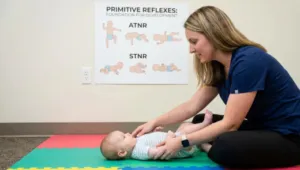
ATNR: The Asymmetrical Tonic Neck Reflex
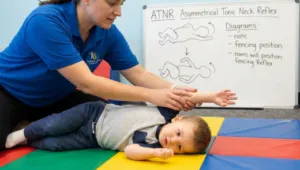
The ATNR reflex operates as one of those early neurological patterns that most parents never notice until something seems off when a baby turns their head to one side, the arm on that same side extends while the opposite arm bends, creating what therapists call the “fencing position.”
This involuntary movement typically emerges around 18 weeks in the womb and should naturally integrate by six months after birth, yet when it lingers past this age, you’ll see children who struggle with hand-eye coordination, crossing the body’s midline during activities like writing or catching a ball, and even focus issues in the classroom because their head movements constantly trigger those primitive patterns.
What makes ATNR particularly fascinating from a neurodevelopment perspective is how it directly impacts both gross motor and fine motor skills retained ATNR doesn’t just affect physical abilities but creates a cascade where visual tracking, bilateral integration, and even self-regulation become challenging, which is why occupational therapists prioritize ATNR integration exercises when addressing developmental delays in toddlers and older individuals, especially those with ADHD, Autism, or sensory processing disorders.
What You Need to Know About STNR
The STNR emerges as one of those involuntary movement patterns that infants naturally develop around two months a brief window where the reflex helps newborns transition from crawling to sitting positions.
Unlike its asymmetrical counterpart, this primitive mechanism creates a natural push-pull response: when the head tilts back, legs extend while arms bend; tilt forward, and the pattern reverses, establishing crucial neural pathway development that later supports sophisticated movements in academic settings.
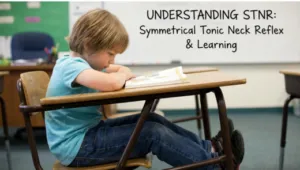
What many don’t realize is how this foundational reflex directly impacts a child’s ability to sit at desks comfortably if it doesn’t integrate by the toddler stage, you’ll often see children struggling to maintain posture during reading or writing, their body constantly fighting against this hidden pre-programmed response that should have faded months earlier.
The Connection Between ATNR, STNR, and Development
When ATNR and STNR reflexes aren’t fully integrated during their typical integration period, children often experience challenges across various areas of development, from physical abilities like hand-eye coordination skills and postural skills to cognitive functions, including attentional skills, ocular motor control, and visual spatial skills.
I’ve observed that these retained primitive reflexes create a foundational roadblock where the brain struggles to develop higher-level skills because the nervoussystem remainsstuck in active in survival mode rather than allowing motor skills, behavior, and learning to progress naturally.
The importance of seeking professional care like an occupational therapist becomes clear when you notice consistent struggles with movement, coordination, or even communication skills. Thesesigns highlight how retained primitive reflexes canaffect everything from balance to mental skills, making exercises designed to integrate ATNR reflexesabsolutely crucial for addressing these motor delays and paving the way for optimized learning.
Warning Signs of Persistent ATNR and STNR
When retained reflexes linger beyond their typical integration timeline, certain areas of development become affected in ways that present themselves through daily struggles, fine motor skills like handwriting feel awkward, gross motor skill development shows up as clumsiness during physical activity, and even visuo-spatial skills create difficulties when crossing the body’s midline during everyday activities.
These retained patterns, if left unaddressed, can struggle to support the critical foundations needed for success in school and self-regulation, making it crucial to recognize how both ATNR and STNR mechanisms are responsible for creating the neural pathways that enhance a child’s ability to move with coordination through targeted ATNR Reflex Integration Exercises, whether they’re creating art, crawling through obstacle courses, or simply living their day-to-day life with body awareness intact.
The Advantages of Reflex Integration Therapy
From my years of working with children struggling with focus and coordination, I’ve witnessed how retained primitive reflexes create invisible barriers to learning. Integration exercises offer something groundbreaking, not just symptom management, but actual neurological rewiring that supports development from the foundation upward.
What makes these exercises particularly effective is their ability to address developmental gaps that impact ADD challenges, sensory processing, and speech delay, creating a ripple effect where improved physical coordination naturally enhances cognitive abilities.
The key lies in consistency; regularly practicing these movements and activities helps strengthen the brain’s capacity to integrate conflicting motor patterns, ultimately paving the way for smoother transitions between skills like reading and writing.
I’ve seen young learners transform when we use targeted reflex integration exercises through programs like Soundsory, which combines auditory input with movement patterns, proving that the body and mind truly work as one fundamental system in achieving optimal growth.
Proven Reflex Integration Activities
Primitive reflex integration therapy is often made up of targeted reflex exercises that help retrain the body by integrating reflexes, which can improve function and allow previously blocked neural pathways to open, helpful for conditions like ADHD and Autism, where sensory integration and listening therapy are common interventions that can make a huge difference.
Studies show that exercise helps improve attention in ADHD, while research on exercise and Autism is showing that exercise improves Autism traits and parent-perceived quality of life; the Soundsory program combines listening therapy with exercises designed to integrate reflexes while working simultaneously to improve neural neurodevelopment, creating a fabulous combination that offers genuine insight for anyone on the Autism spectrum
Through three different levels of equipment-free supportive reflex integration exercises used in conjunction with therapeutic practices, an approach I’m genuinely excited to share as it provides real benefit and remains important for families seeking effective support.
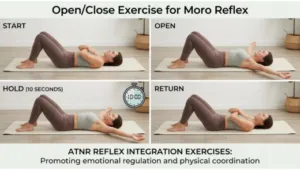
1-The Open/Close Exercise for Moro Reflex
Start by lying on your back with arms crossed over your chest, then suddenly open them wide while simultaneously lifting your shoulders slightly off the floor hold this position for 10 seconds before returning to the starting position with arms crossed again; this exercise helps integrate the Moro reflex, which is important for emotional regulation and sensory processing, and when done consistently as part of ATNR REFLEX INTEGRATION EXERCISES, it strengthens the body’s ability to transition from survival responses to more complex motor skills, promoting better bilateral integration and physical coordination while supporting overall development in both children and adults who may have retained this primitive reflex beyond infancy.
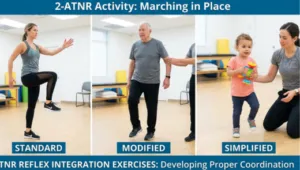
2-ATNR Activity: Marching in Place
Stand with your back straight, then begin marching by lifting your right knee while raising your left arm fully extended in front. Repeatthis opposite coordination for 10 steps.
The modified version allows you to walk in place without maintaining parallel alignment, while guide support may be needed for those who find the position challenging.
For the Simplified approach, encourage six steps with holding a toy to engage attention and make movement safe. This exercise serves as a fundamental progression in ATNR REFLEX INTEGRATION EXERCISES, related to developing proper coordination.
3-Zombie Walk Activity
Zombie Walks target ATNR by having you stand with arms extended straight in front, then march forward while keeping your head turned to one side for 10 steps pause, turn your head opposite, and repeat the march, noticing how maintaining the turned neck position while moving forward challenges upper and lower body coordination; for modified versions, walk more slowly or hold a wall for balance, and in simplified form, step in place with hand support to encourage practice without the awkwardness that can occur when your visual field stays left or right as you advance.
4-Silly Crawls (ATNR Activity)
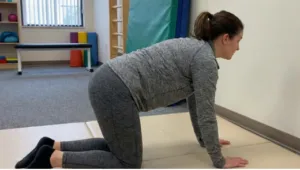
ATNR Reflex Integration Exercises. Crawling backward might seem odd at first, but when your ear stays aligned and your head turns naturally toward the wall, this movement catches real attention for ATNR integration. Lookhow crawling in reverse creates a neurodevelopmental reset that most forward-only activities miss entirely.
5-Silly Crawls in Reverse
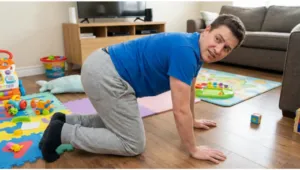
ATNR Reflex Integration Exercises. Start by positioning yourself on all fours with your hands and knees firmly planted on the floor, then reverse the typical crawling motion by moving backwards instead of forwards this backward movement challenges the ATNR patterns differently, requiring your head to turn in the opposite direction while you crawl in reverse, maintaining coordination as you navigate the space behind you without looking, which strengthens cross-lateral integration and spatial awareness through this playful yet purposeful exercise.
6. The Superman Activity
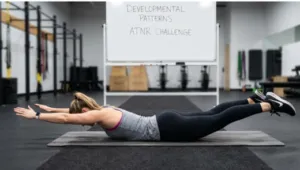
ATNR Reflex Integration Exercises. From my years working with developmental patterns, I’ve noticed the Superman pose works differently than most expect lie on your stomach against the floor, then simultaneously lift both arms and legs off the ground, creating what feels like static suspension that muscles throughout your body must develop to maintain, which directly challenges ATNR patterns by requiring bilateral coordination without the typical left-right dominance that retained reflexes create.
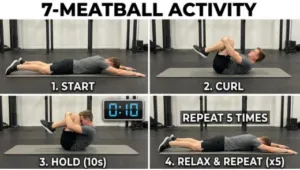
7-Meatball Activity
ATNR Reflex Integration Exercises. Lie face down on the floor with your belly pressed against the ground, then slowly curl your body into a tight ball by bringing your knees toward your chest while wrapping your arms around your legs, holding this compact position for 10 seconds before relaxing and returning to the starting position, rest briefly, then repeat the movement 5 times to help integrate the ATNR reflex through controlled flexion that challenges body awareness and muscle coordination.
8-The Cat/Cow Activity
ATNR Reflex Integration Exercises. Cat-cow stretch positions you on all fours, where arching while looking down engages STNR integration mechanics, then curve the spine while looking upward to activate opposing muscle chains. Performthis movement slowly for maximum benefit across upper and lower body coordination, which adds depth when doing.
ATNR works since the neck position directly influences limb posture and vision skills through yoga-inspired movement that babies naturally use during the transition phase around six months before reflex patterns become integrated by 9 to 11 months, making this an example of reflex integration exercises.
particularly fundamental for anyone known to have retained patterns that impact learning and development by addressing how hands and knees position affects straightened legs versus bent arms responses through the STNR reflex mechanism.
The Baby Cobra Activity
ATNR Reflex Integration Exercises. The baby cobra position involves lying on your belly with elbows bent and hands near shoulders, then lifting your chest slightly off the floor while keeping straightening minimal hold for 5 seconds, then rest another 5 seconds before switching to bending your right knee, creating a slightly rotated posture that encourages cross-lateral leg coordination through time-controlled pausing that briefly engages the entire spinal way of movement, which assists in ATNR reflex integration exercises by challenging positional awareness where one count through 10 repetitions becomes the standard practice protocol.
FAQs
Q: How does the Moro reflex exercise help when someone wants to sit down and work on primitive reflexes?
A: Tilt slightly with open arms, then lean forward to cross this pattern, whichhelps the top of the body respond correctly.
Q: What makes backwards movement essential during STNR integration exercises?
A: Moving backwards creates reverse sense compared to typical forward motion, forcing the brain to retrace neural pathways and establish better support.
Q: Why do obstacle courses with tunnels and cushions feel more fun than standard exercises?
A: Climbing through simple setups makes challenging movements feel like play, which is ideally how human development should consider motor learning.
Q: Can you include modified movements if keeping your balance at 90 degrees feels too difficult?
A: Absolutely – modified versions allow support for those who wonder how to start without the full hold time of 20 seconds.
Q: What role does attention play when you rest between lifting your chest off the floor?
A: Focused attention during rest helps your nervous system observe changes and unpack what’s happening in each motion, making targeted improvements stick.